Old School Runescape (OSRS) continues to attract more than 120,000 concurrent players, despite having graphics from the dial-up age and playing like a CAPTCHA with far too many extra steps.
For context, that concurrent player number puts it above pretty much every modern MMO with 10-100x the budget and developer count.
How is this possible? Why is a browser game from 2007 still dominating? And how on earth do you get people to click pixels for thousands of hours?
The answer is simple: OSRS has an absurdly effective progression system. It bears repeating that this system somehow gets millions of people to do thousands of hours of what would be considered chores in any other context.
Yet, bizarrely, it’s the only one of its kind.
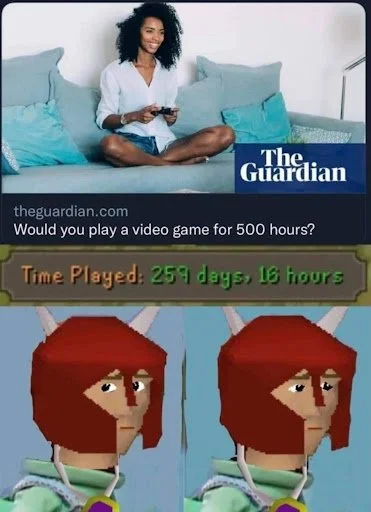
A “Short” Summary
Here’s how Old School Runescape (OSRS) works:
Gathering skills produce resources
These resources are used by production skills to create useful things like potions and weapons
And these useful things are used in combat to level up combat skills and fight more powerful enemies.
And, thanks to the player-driven economy, if you don’t like a particular skill, you can partially skip it with the gold you get from activities that you do like (if you’re not an Ironman character).
As you level up these skills, you unlock new item and resource tiers, quests, achievement diaries, bosses, and other objectives.
Completing these will give you unique rewards that help you further level up your skills and unlock even more objectives, as you make your way towards 99 in all skills and a “completed” account.
And, while you do that, you can show off your hard work through hard-to-earn cosmetics and your placement on the leaderboard.
Now, to understand why the above system works so well, let’s go through the unique feelings that make Runescape’s progression system creates:
1. Progress feels valuable because objectives are completable
Old School Runescape’s (OSRS) designers chose to go with fewer objectives that require long grinds, as opposed to more objectives that each require shorter grinds. This is the opposite of how most other MMOs work.
More specifically, OSRS has 157 quests and will likely never change the max skill level of 99. World of Warcraft, by comparison, has 34,000+ quests and a continually increasing level cap.
Since players know OSRS’ developers won’t suddenly add 300 new quests nor raise the level cap, these long-term objectives feel completable.
And because they feel completable, players are much more motivated to do them just for the feeling of closure or “getting grinds out of the way”.
Players are instead kept playing through exponentially increasing experience requirements, where getting just one of the 23 skills to max level can take 100+ hours. And players stick around through these insane grinds only because they’re completable.
It also helps that the time between levels scales with the player’s sunk cost and the 1-99 system cleverly tricks them into thinking they only have a “few levels” left, when those last few levels will take tens of hours.
It’s a smart way to retain players without needing to throw millions at developing new content every month.
2. Progress feels valuable because there are status symbols that aren’t invalidated by monetization
The game has a bunch of hard-to-earn items that are visually distinct from all other items, so players are motivated to chase them for social status and a general sense of achievement.
And this is only really possible because there’s no cash shop to flood the game with paid cosmetics that would dilute the value of these genuinely earned items.
There’s also no form of purchasable experience booster or level skip that would destroy the social status and sense of achievement that comes with progress in the game.
Leveling a skill up to 99 just wouldn’t feel the same if you know that (1) people can just swipe their credit card to get there with no effort and (2) everyone else will assume you did the same.
The one exception to the rule is that OSRS lets you buy gold with either in-game or real currency via the Old School Bond.
But no amount of gold lets you skip past many of the hundred hour grinds, and players generally accept bonds as a necessary evil to combat scammy 3rd party gold sellers.
But, of course, there’s a tradeoff with this approach. The lack of monetization means that OSRS doesn’t earn as much per player as its competitors or even its more modern brother (Runescape 3).
3. Progress feels valuable because every objective grants unique rewards that tie into all major systems in the game
Every quest you do or skill you train will tick off requirements for at least a few other quests, region-specific task checklists, and other checklists like your collection log (which tracks all the unique item drops you’ve ever gotten).
This makes objectives feel exceptionally valuable, since it feels like you unlock a whole new world of activities every time you complete an objective. Possibility itself is made into a reward.
And, here’s the really smart part: completing an objective usually comes with a wide range of convenience and power upgrades that no other objective provides.
These include everything from new teleport locations to better grinding spots and perks to make grinding some enemies more convenient. Because rewards are unique, objectives don’t cannibalize each other.
This is exceptional because, if I do a low-level quest in WoW, all I get is some gold and experience that’s no better than any other quest at that level and trivial compared to what I’ll get from endgame quests. It feels like a complete waste of time.
If I do a low-level quest in OSRS, on the other hand, I might unlock a new, unique teleport location that’ll be useful for the rest of my time in the game.
That’s why the “real game” starts at endgame in WoW and minute 1 in OSRS. There’s a huge, huge difference in the longevity of content.
This “everything I do matters” feeling also comes with a host of other benefits. Players will start spending their time away from the game thinking about what they want to do in their next play session, often with their friends. That’s great for retention and word of mouth.
And, once they get to that session, there are so many valid options that they’ll probably end up deviating from their plan and just doing what they felt like.
This is important because logging in and getting to do whatever you feel like doing prevents burnout, which lets the game get away with what would be considered highly repetitive or low-quality content in any other game.
4. Progress feels valuable because the well-balanced player-driven economy makes sure that you can earn gold from anything and buy anything with it
Thanks to the player-driven economy, even if you already have all the items that a particular boss drops, you can still sell them to someone else to buy something that you don’t have.
That applies to pretty much any activity in the game, so you can do activities you want to do and then use gold from that to skip over things you don’t want to (unless you chose to go with an Ironman account, which can’t trade). It’s basically a form of content personalization.
It’s also crucial that enough resources are continually taken out of the economy using resource sinks, so that items (and the grinds behind them) maintain their value.
These sinks range from a huge list of consumables that are required in combat (like potions, food, ammo, and runes) to an auction house tax and even a skill that’s progressed by basically dumping a huge bunch of gold into it (Construction).
Even items that are less useful to players still maintain their value over time because the game has price floors, like NPC vendors and the High Alchemy spell. Even if you get a completely useless sword from a drop, you can always just cast High Alchemy to turn it into a sum of gold.
The net result is that even killing low level cows will grant you enough gold to buy better items. So even old, low-level content feels rewarding, which is a great feeling and great for the longevity of the game.
5. Progress feels valuable because old content doesn’t get invalidated by new updates
In most other games, items and enemies are mostly invalidated when the next expansion comes along. This doesn’t happen in OSRS. That’s because of four choices:
Stats for items and enemies scale linearly (and generally much slower than in most other RPGs), so old, lower-level weapons can still technically be used to kill a new boss that came out 10 years later.
There are 5 attack styles and a separate defense stat for each style, so new best-in-slot items only invalidate items that are good at that same style. That multiplies the potential number of upgrades by 5x.
Items tend to have some kind of niche utility, like a unique special attack that reduces an enemy’s defense level or a passive effect that causes it to deal more damage to dragon-type enemies. So an old weapon might still be useful when fighting some subset of enemies that are uniquely weak to it.
Newer items are sometimes crafted using older items, so the old items still remain useful and valuable.
Thanks to these choices, the things you unlock carry their value all the way to the endgame. Every grind feels like it matters, and that adds a lot to the game’s longevity.
Again, that’s a stark contrast from other MMOs, where the “real game” only starts at the endgame and the rest feels like useless filler.
6. Players get hooked because there are so many objectives that there’s always another one that’s close by
From quests to achievement diaries, skill levels, item tiers, and bosses, the huge list of objectives makes it so that you usually have at least one meaningful objective you can complete within 30 minutes of playtime.
That makes it hard to find a good time to stop playing or quit altogether. You always have an objective that you “might as well do before logging off”. This is the essence of any successful progression system, and OSRS is no different.
There are also some objectives that function on real-world timers, like the Farming skill. Since they involve going away and coming back to reap your rewards after some time, they ensure that there’s at least something you can complete even if you choose to take on a longer grind with few milestones in sight. Without this, players might get bored and quit in between objectives.
But, while having lots of meaningful objectives is generally a good thing, it also means that new players have an overwhelming number of options when they first log into the game.
That’s a huge bottleneck for OSRS, since a lot of new players aren’t going to put in the effort to learn what they can and should be doing before they’ve become invested in the game.
7. Players get hooked because they’re always at least part of the way towards completing the next objective
In general, rewards for activities and objectives overlap with the requirements for other objectives. For example, when a player takes on a Slayer task (which is basically a repeatable mini-quest to kill some number of a specific enemy), they’re likely:
Training at least five separate combat and non-combat skills
Knocking down a few skill requirements for some quests and achievement diaries
Earning Slayer points to be exchange for Slayer items and perks
AND earning gold and resources needed to train other skills.
When objectives overlap like this, the player feels like they’re drowning in value. And they’re constantly going to be at least part of the way to some milestone, like level 70 Defense or the requirements for an important quest.
The outcome is that it’s easy to keep finding motivation for the next grind. You’re already part of the way there, right?
8. Players stay motivated because there’s not much time-gating that would force them to do things they don’t want to do
Because OSRS manages to maintain the gameplay value of its old content, it doesn’t need to rely on time-gating to retain players (like daily/weekly quests).
The result is that players generally feel a sense of agency, which prevents the very, very repetitive tasks from feeling like chores.
The difference between a “chore” and a “grind” is whether a choice was involved, and OSRS provides plenty of choice.
The exception to this is Ironman accounts, which can’t trade. The problem is that they often don’t have alternative ways to easily get the resources that time-gated activities provide.
So, when players log in every day and feel compelled to do the same list of tasks (because missing out on them would feel like a waste), they’ll start burning out pretty quickly.
All that being said, the lack of time-gated objectives also worsens the problem where new players can feel overwhelmed by the number of things to do.
Sometimes it's nice to have a list of a few exceptionally rewarding tasks per day, instead of setting your own objectives each time.
But there are other games out there for players looking for that, and OSRS wouldn’t work if it relied on time-gating.
9. Players stay motivated because there’s a variety of content for every mood and situation
In OSRS, if you want high-intensity thrills, you can play full-loot PVP or kill difficult bosses.
If you want to chill while watching Netflix on another monitor, you can chop trees or go fishing. Or you can chop trees or fish the “hardcore way” if you want more intensity in exchange for more experience per hour.
You can even play on your phone on your commute or monitor graphs of item prices to plan your next speculative investment.
And none of it feels like a waste of time because of how well OSRS maintains the value of all of its content.
This means that the game is remarkably resilient to a player’s lifestyle changes and doesn’t compete with most other forms of entertainment — you can always watch whatever show is hottest or even work or play another game with OSRS on a second monitor.
It just feels great to have a game where you can always do something and that something will feel like it permanently takes you one step closer towards account completion.
10. Players withstand grinds because they are optimizable
Most grinds have some way to “game the system” for better gains.
This could be anything from exploiting a (purposefully unpatched) bug to catch fish at triple the normal rate or taking advantage of upgrades to optimize your route between the grinding location and the bank.
The result is that players get at least partially distracted from the fact that they’re clicking on pixels for 20 hours just to see a number go up from 95 to 96.
11. Players withstand grinds because they don’t require much attention
OSRS gets away with long grinds because many of them only require a few inputs per minute or little attention in general.
That way players can focus on something else, while still feeling like they’re doing something to get the reward (in contrast to a full idle game).
Some OSRS content is more intense, on the other hand. But this too usually involves sequences of inputs that are fast and predictable enough that they can be ingrained into muscle memory, which makes them feel rhythmic and effortless. This is the case for bosses and the fastest skill training methods.
We can see how important this is when we look at content that’s in the awkward middle ground, where you need to intervene often but inputs aren’t fast and predictable enough to get a real rhythm going.
Content that fits this description is almost universally despised, like the Mining, Runecrafting, and Agility skills.
Moral of the story: when you’re asking a player to do something 100,000 times, it better require minimal attention or be learnable to the point where it requires minimal attention.
12. Players withstand grinds because they keep players in shared spaces, so that they can talk to each other to pass the time
Short spawn times for resource nodes and fixed node spawn locations make players gather together in the same space while training skills.
When players are in the same space, have a clear commonality (i.e., training the same skill), and have nothing else to do, players will naturally start talking to each other.
As they do, they make long grinds more bearable for each other and gradually form friendships.
These friendships will then keep them in the game for years and even make grinds more valuable, since you now have in-game friends to talk to, compete against, and show off to.
A whole lot less players would’ve bothered to get a skill to 99 were this not the case.
13. Players withstand grinds because there’s no clutter to outcompete audio-visual feedback
OSRS’ simple, old-school UI, art, and sound turns off some players, there’s no doubt about that.
But they also make it so that each level up effect, stack of items, and new item upgrade stands out much more.
It’s just much more satisfying to watch your inventory fill up or admire your skills when there aren’t 500 colorful UI elements or intricate environmental details that are competing for your attention.
When the game is about clicking pixels for thousands of hours, little things like this matter a surprising amount.
14. Players withstand grinds because the game uses variable reinforcement in every system
The core combat loop in OSRS involves clicking an enemy and then watching as your character attacks it.
That would get boring incredibly fast, were it not for the fact that every hit is a gamble between 0 and your max hit. It feels satisfying to get huge value from a streak of big hits, and anticipating these streaks at least partially keeps boredom at bay.
But clever use of “gambling” isn’t just limited to combat. Gathering and production skills also deliver rewards at varied, rather than fixed, intervals. For example, players might get their first fish after 3 seconds and their second one after 1 second.
Again, the player will start to anticipate those satisfying moments where you get a streak of quick catches to instantly fill up their inventory. If the game instead always handed out a fish every 3 seconds, the fishing grind would be far less bearable.
And, like in many other games, this idea also applies to item drops. What separates OSRS from the rest, though, is that drop rates are very low.
That scarcity makes drops feel valuable and desirable, even if they’re not that much better than the next best item.
It’s an effective way to keep players playing for a long time because we’re naturally bad at probability and we continually feel like the next kill might be the one (even if there’s a 1/5000 chance of that being the case).
But, crucially, these rare drops are unique to particular enemies, so that players can set item grinds as objectives that keep them hooked in the game.
If they just dropped from every enemy randomly, there would be less objectives to motivate gameplay and the game wouldn’t be nearly as effective.
Conclusion
The secret behind OSRS lies in how it manages to make every activity feel valuable. It does this by tightly linking objectives together and ensuring that they feel completable, uniquely rewarding, and therefore evergreen.
Because every activity feels valuable, players will gladly go through huge grinds — even more so when everything is full of variable reinforcement and is easily completed while watching Netflix on another screen.
And, critically, there’s no form of monetization that would dilute the value of completing these objectives, nor any form of time-gating that would make those objectives feel like chores that players are forced to do.
The net result is the most effective progression system in all of gaming, considering that the game really is just clicking on pixels for 10,000 hours and 120,000+ people are doing that as we speak.
I would really recommend also watching this video by Marstead, since he dives into more detail on many of the topics I’ll cover in this post.
How it Works
To fully understand why OSRS’ progression system is so magical, it’s worth going through all of its major components first. I recommend skipping this part if you’ve played the game before.
Gathering Skills
OSRS has a bunch of different resource types: logs, ore, food, herbs, gems, etc.
These are split into resource tiers. For example, you have normal Logs and then Oak, Willow, Teak, Maple, Mahogany, Yew, Magic, and Redwood logs, plus a few other niche ones.
You get these resources by using your gathering skills: Woodcutting, Mining, Fishing, Hunter, and Farming.
Each tier of resource is gated by your level in the relevant skill. For example, you can’t chop Oak trees until you chop enough normal trees to get level 15 Woodcutting. Then, once you chop enough Oak trees, you can move onto Willows at level 30, and so forth.
At each new tier of resource, you get a satisfying jump in experience per hour and (usually) gold per hour.
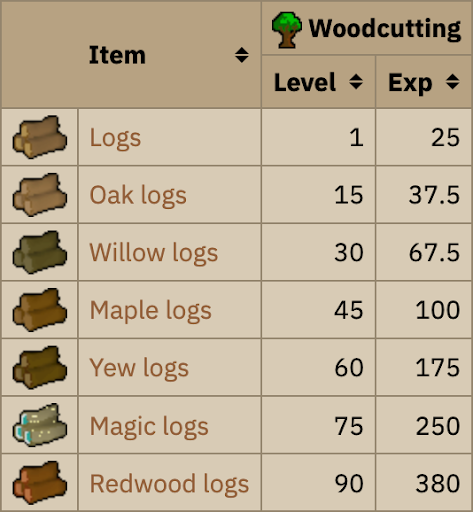
Log type by Woodcutting level and experience gained per log. Source: OSRS Wiki
Beyond unlocking new tiers of resources, leveling up a gathering skill also increases your gathering speed slightly and you also unlock better tools that boost your gathering speed much more substantially.
These tools are split into tiers as well. For Woodcutting axes, you have Bronze, Iron, Steel, Black, Mithril, Adamant, Rune, Dragon, and Crystal. Each increases your gathering rate by about 10%, which feels satisfying enough to turn the next item tiers into an objective that players look forward to.
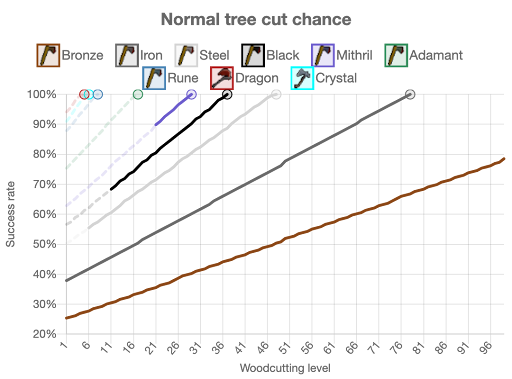
Normal tree cut chance by axe type and Woodcutting level. Higher success rate = faster gathering. Source: OSRS Wiki.
Production Skills
Once you have a bunch of resources, you can turn them into useful things with production skills: Fletching, Smithing, Cooking, Crafting, Runecrafting, Firemaking, Construction, and Herblore.
So I can, for example, use my Fletching skill to turn those logs I chopped earlier into wooden shields, shortbows, longbows, crossbows, arrows, javelins, darts, or bolts. I’ll gain a chunk of Fletching experience every time I fletch one of those items, with each item giving a specific amount of experience.
My options here are also gated by your level in that skill. So I can only fletch Willow short bows after I’ve made enough, say, Wood and Oak shortbows to get level 35 Fletching.
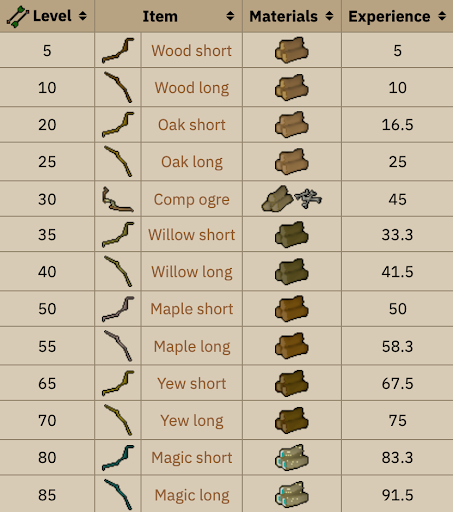
Bow type sorted by Fletching level requirement. Source: OSRS Wiki
Combat Skills
Then you have combat skills: Attack, Strength, Defence, Ranged, Magic, Hitpoints, and Prayer. These increase your damage and defenses in combat, so that you can fight higher and higher level enemies.
Combat skills are trained by dealing damage with the relevant attack style (ranged, magic, melee) and enemies tend to be weak to one of these styles. So, if I want to kill enemies that are weak to ranged attacks, I’ll need to train my Ranged level.
And, to do that, I’ll need a bow and lots of arrows, which I fletched using the Fletching skill with the logs that I chopped with Woodcutting.
If I want to kill enemies weak to magic, I’ll train my Magic level. For that, I’ll need a staff from Crafting and lots of ammo for spells (runes) from Runecrafting.
And, if I want to kill enemies that are weak to melee, I’ll train my Attack, Strength, and Defence skills. But, unlike with Ranged and Magic, I don’t need ammo.
Instead, I’ll have to get up close to enemies, which means taking damage. So I’ll need to heal myself with food that I fished with Fishing and cooked with Cooking.
While I’m training any of those skills, I’ll also be using potions to temporarily boost those skills and regain the stamina I lose by running around constantly. Thankfully I created those potions earlier with my Herblore skill using herbs I got from Farming.
These combat consumables are incredibly important, since they’re ultimately what gives production skills a reason to exist beyond pure number go up. Without consumables, resources would accumulate infinitely, prices would converge to zero, and production skills would feel far less valuable.
And you can’t trivialize combat with infinite consumables because your inventory is limited to 28 items, with each consumable taking up one spot. If you run out, you have to run back to a bank to grab more items, which forms the basic loop of the entire game.
In a nutshell, everything is neatly connected together by the tiered crafting system and a combat system that uses up the things you crafted.
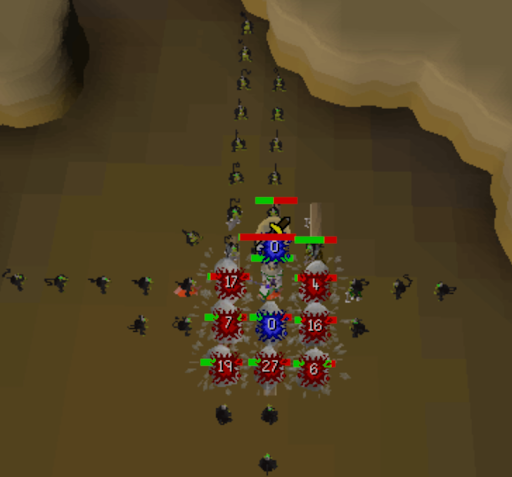
A player training Magic by killing hordes of monkeys. Each time you cast a spell, you consume runes (which are crafted using Runecrafting) and gain experience based on the damage you dealt. Source: OSRS Wiki
Utility Skills
OSRS also has a few utility skills: Construction, Agility, Slayer, Firemaking, and Thieving. These are more like separate minigames that aren’t as heavily tied to the game’s other systems, but still consume resources and provide useful rewards.
As one example, you can use logs from Woodcutting to train up your Construction and build a player-owned house.
When upgraded, your house lets you save time with teleporters or a rejuvenation pool that lets you replenish your health without needing to waste food (but only when you’re at your house).
You can also invite people over or generously donate your expensive Prayer altar for the use by the public, so that you can flex the furniture you bought with 100mil+ gold. Using someone’s altar is one of the best Prayer training methods, so people will actually come to your house (unlike in most other MMOs).
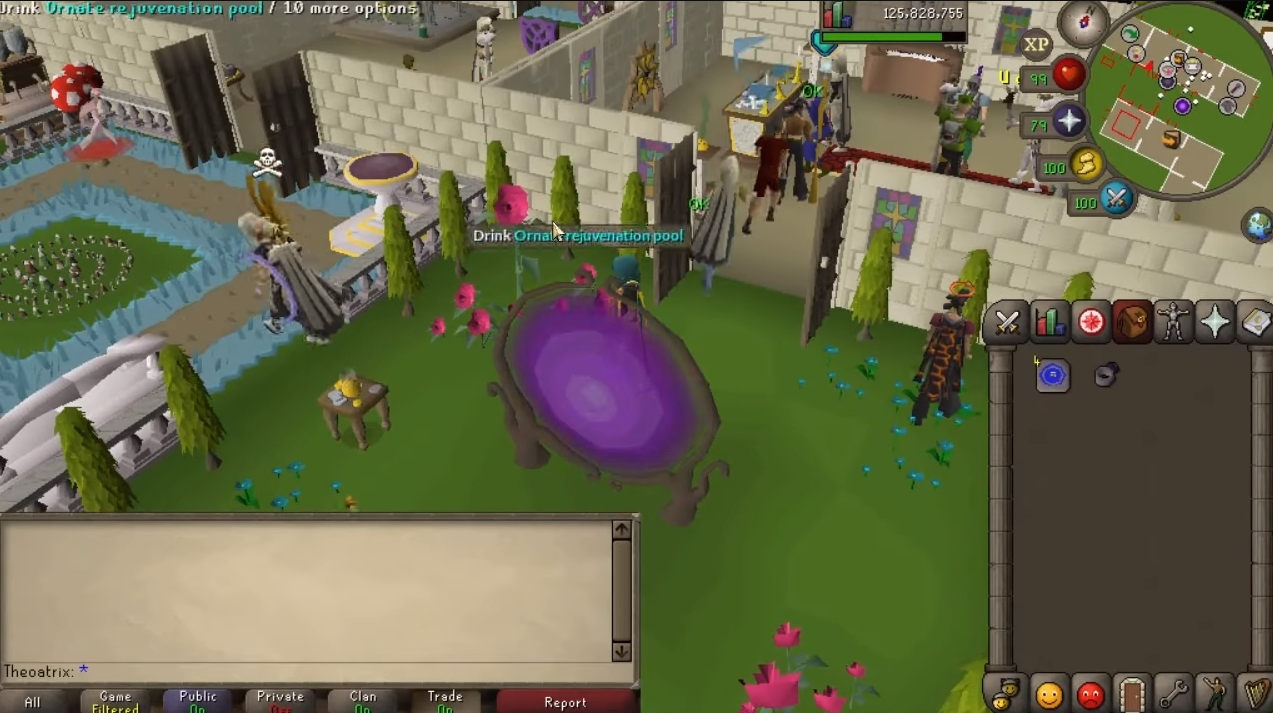
A player-owned house, with people running to the altar to train Prayer (since they get an extra bonus for using an altar that a relatively small number of players can afford). Source: Theoatrix
Player-Driven Economy
I mentioned earlier how players could turn logs into arrows that they use to fight enemies. In reality, though, most players don’t actually need to go through that whole process themselves.
That’s because everything in the game is tradeable (unless you decide to create an Ironman character, which doesn’t have access to trading — although they too can get items from NPC vendors and enemies so they don’t have to craft everything manually either).
So instead of having to make potions themselves, players can specialize in the activities that they want to do, earn whatever resources they get from those, sell them to other players, and then buy the potions they want with that gold.
And, if you want to train a skill that you don’t like, you can usually use gold to skip some of the grind with a faster but more costly training method.
Everyone has different preferences for what they want to do and when, so the player-driven economy basically functions as a form of content personalization in a system that would otherwise force you to interact with every skill all the time.
Plus, it also creates a “play the market” minigame for the small group of players that enjoy finding opportunities to make money, either by trying to predict the movement of prices or by exploiting differences in price levels between vendor prices and the player-driven market.
Quests
All of the above wouldn’t work without the long-term objectives that provide structure to the player’s path through the resource tiers and skill levels. The first and most important type of objective is the quest.
Quests take players on adventures across the game world, where you talk to NPCs, fetch items, solve puzzles, and fight enemies.
These quests are long and intricate, which OSRS players say they love. But unspoken truth is that most quest steps are so obscure and the running distance between steps is so long that 99% of players will just do whatever a quest helper plugin tells them to do.
It’s either that or you’ll spend hours trying to find who you’re supposed to talk to, then run for another hour because you actually needed to give them an item that the game never bothered to tell you about in advance. It’s incredibly annoying.
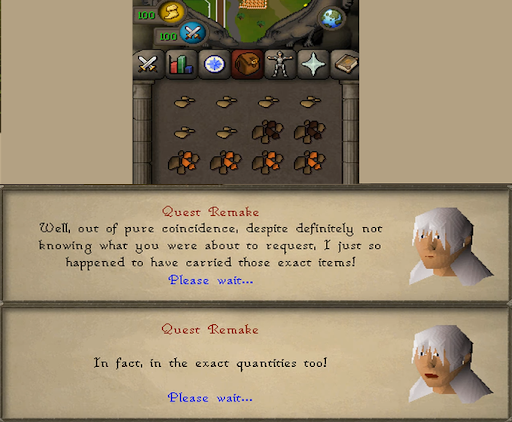
So only newer quests are doable without a guide and the real reason why players love quests is that they feel exceptionally valuable.
That’s because quests are long and there are a finite number of them, so they can grant very valuable rewards compared to what you get from grinding skills or bosses (without invalidating those other grinds).
These rewards might be basically anything, like:
Handing out a huge chunk of experience for some set of skills
Unlocking a new shortcut or teleport location that lets you traverse the map faster
Granting access to a new area that may unlock anything including a new item grind, minigame, boss, or better grinding spot for some skill
Unlocking a new skill
Unlocking a new set of magic spells or prayers (buffs)
And/or unlocking items or removing restrictions that prevent you from using them.
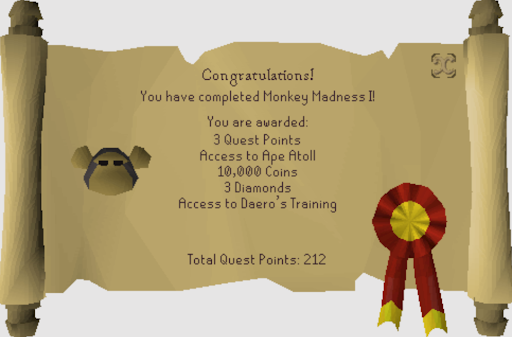
Quest rewards for the Monkey Madness quest.
Completing a quest is a big enough jump in progression that they turn into major objectives that players look forward to.
As one example, the Waterfall Quest only takes about 30 minutes, but it gives you enough experience to go from level 1 to level 30 in Attack and Strength. That’s much faster than killing cows to level 30, so it’s one of the early quests that everyone loves.
Every quest also has a list of requirements that you need to complete before starting them. These take the form of prior quests and a set of minimum skills requirements.
For example, you can’t do the Animal Magnetism quest until you’ve completed 3 quests (Restless Ghost, Ernest the Chicken, Priest in Peril) and trained 4 skills (level 18 Slayer, 19 Crafting, 30 Ranged, 35 Woodcutting).
Because quests grant big bursts in progression and come with that list of requirements, they encourage you to play through all the game’s content and generally provide structure to OSRS’ gameplay.
So, while most other MMOs have you moving from zone to zone as you level up towards max level, you (mostly) move from quest to quest in OSRS on your way to maxing your skills.
Here’s what that feels like in practice: You want that juicy experience from the Waterfall Quest? Well first you’ll need to get around level 20 in your combat stats, since you’ll need to run past some high level enemies during the quest that might otherwise kill you in 1 hit.
After you’ve done Waterfall Quest, maybe you want the Ava’s Accumulator item. It picks up arrows for you, boosts your ranged stat, and makes ranged training much more convenient. It feels like a loss to train ranged without it, so you set your sights on Animal Magnetism.
But, before you can start that, you’ll need to complete a few quests, as well as train up your Slayer, Crafting, Ranged, and Woodcutting. And those required quests have their own requirements, so you’ll need to complete those first.
Then you also realize that the fastest way to get the level 19 Crafting is to do a few other quests. And you might as well get the Ardougne teleport from the Plague City quest, since that’ll save you so much time during the whole process.
So you started with one objective and suddenly have 15 sub-objectives that all feel valuable easily achievable within a few play sessions, which will keep you hooked on the game.
That’s the magic of having a finite number of quests, each with their own skill/quest requirements and unique rewards.
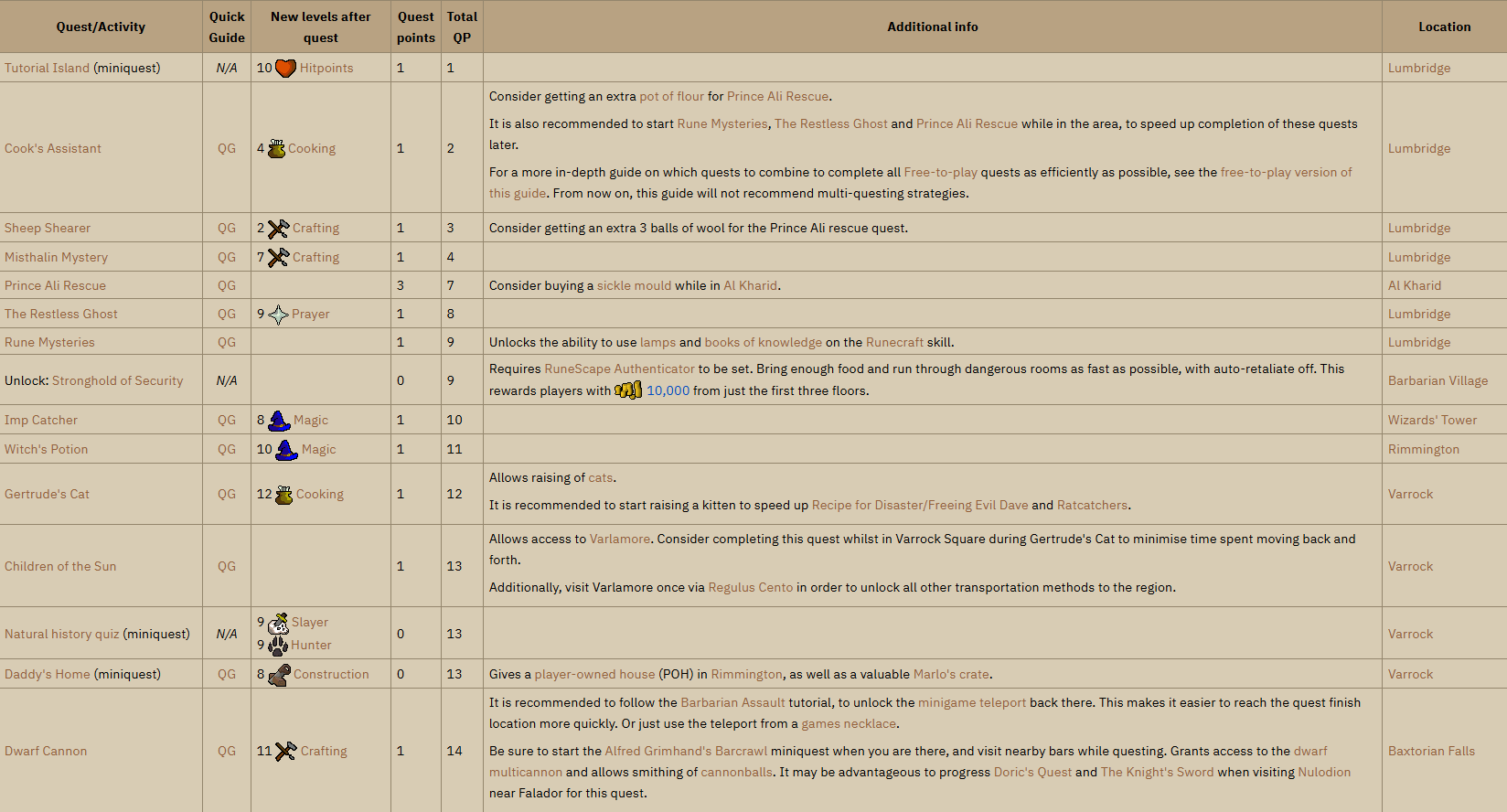
The more-or-less optimal sequence of the first few quests for new players. Source: OSRS Wiki
Achievement Diaries
Achievement diaries are functionally the same as quests. The only difference is that quests involve some sort of narrative and puzzle elements, while achievement diaries are just checklists of tasks you can complete in a specific region on the map.
We’re talking stuff like: “make a rune crossbow yourself from scratch within Witchaven or Yanille”, which requires 10 Crafting, 91 Smithing, and 69 Fletching.
Each of the 12 major regions has its own Diary, and tasks are split into 4 difficulty tiers (easy, medium, hard, elite) based on how hard the requirements are.
So the earlier rune crossbow task is considered “elite” because it takes a long time to train Smithing to 91. Each tier has around 6-12 tasks and completing a tier grants you the rewards for that tier.
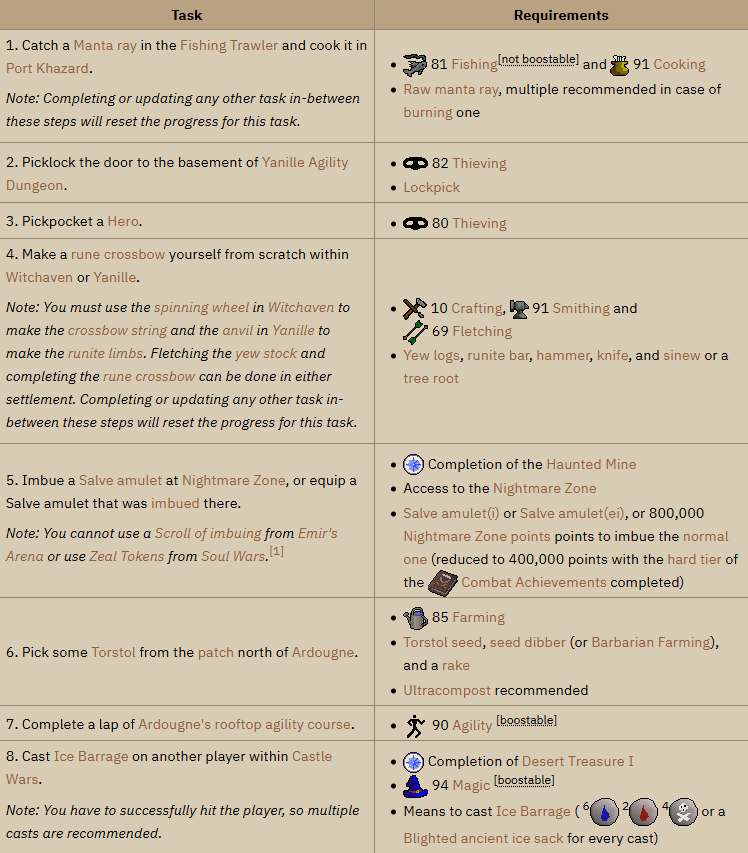
All the elite tasks and their requirements for the Ardougne Diary. Source: OSRS Wiki
These rewards are usually some experience, plus a bunch of region-specific benefits like free teleports to the local Farming patch or more currency gain from a local minigame.
Just like quests, they feel valuable because they offer unique and permanent rewards. Even low level diaries feel like less of a waste of time than max level quests in other MMOs.
and, just like quests, they add structure to gameplay by creating objectives that are directly tied to quests and skills.
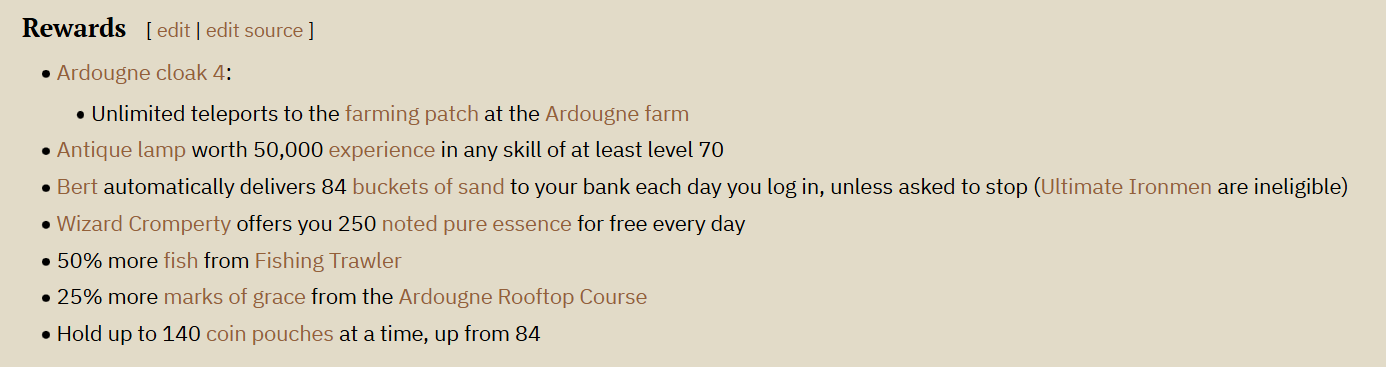
Rewards for completing all the elite tasks for the Ardougne Diary. Source: OSRS Wiki
Bosses and Unique Drops
Then we have bosses. In OSRS, these are difficult encounters that are also locked behind quest, gear, and skill requirements.
Bosses vary in the difficulty of their mechanics, ranging from bosses that require almost no attention if you have the right items (like The Giant Mole) to challenging tests of skill, either alone (TzKal-Zuk) or in a group (the Chambers of Xeric raid).
And, most importantly, each boss tends to have some kind of powerful unique drop that takes a long time to grind for, plus some achievements (like kill that boss in under x seconds), an ultrarare pet drop, and a general drop table that grants some of the highest gold per hour.
Again, because they’re so valuable, they serve as major long-term objectives to motivate your 10,000 hours of clicking on pixels.
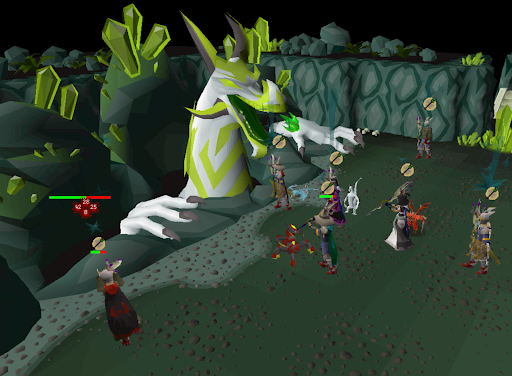
The final boss in the Chambers of Xeric raid. Source: OSRS Wiki
Leaderboards and Status Items
The last important component is the leaderboard and a bunch of hard-to-earn cosmetic items that let players flex their in-game achievements.
Social status is an incredibly powerful motivator and, in OSRS, it’s one of the key reasons that players find grinds worth it.
The best example of status playing a role is the Infernal Cape, which you get from beating the most difficult solo boss fight in the game.
Apart from being the best melee cape stats-wise, it’s also visually stunning compared to every other cape in the game (with animated lava flowing down your back). It makes you stand out, and everyone knows it.
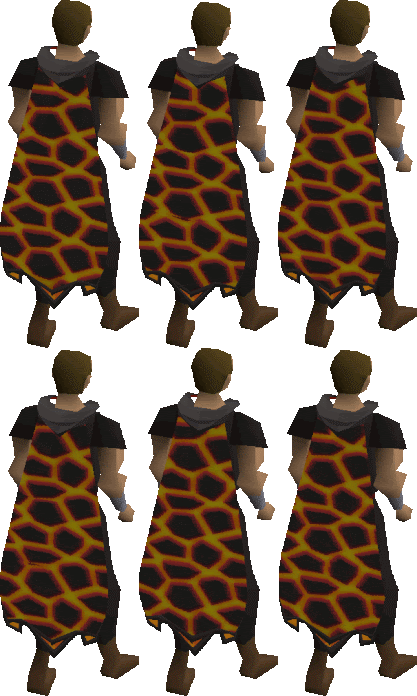
The Infernal Cape. Source: OSRS Wiki
Then you have your skillcapes (earned from reaching 99 in a skill), the Quest Cape (complete all quests), and the Max Cape (reach 99 in all skills).
These are visually distinct and instantly recognizable because they have:
Eye-catching contrasting colors (in the trimmed variant)
More three dimensionality than all other capes, since almost everything else lays flat on your back
Prominent logos for the skill you’ve thrown hundreds of hours into
And cool hoods, which are otherwise rare in OSRS.
They even come with unique animations that let you flex on everyone else while chilling at social hubs like the Grand Exchange (auction house) or the fountain area in Varrock (the biggest town).
If that weren’t enough, you can also combine your Infernal Cape with a Max Cape for the ultimate flex.
Without these hard-to-earn items, the long grinds to complete all quests or get every skill to 99 wouldn’t feel quite as rewarding.
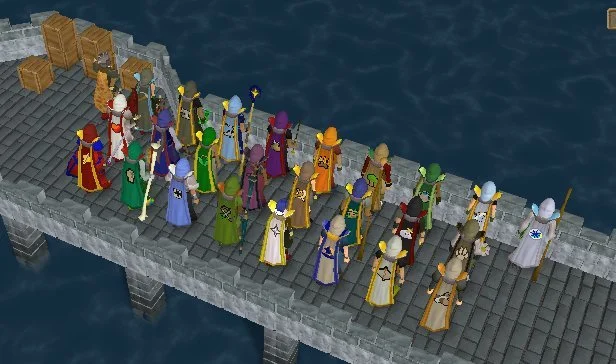
A group of players with their skillcapes. Source: Runetips
Then you also have incredibly rare cosmetic items like 3rd Age and Gilded equipment, which tend to be relatively useless in combat and therefore serve as chase items for flaunting your wealth.
And there are also pets that drop from bosses at very low rates, so you can flex just how many times you’ve killed the most difficult bosses and then collect-them-all to display them in your fancy player-owned house that you’ve thrown a billion gold into.
In a Nutshell
Here’s how Old School Runescape (OSRS) works: gathering skills produce resources that are used by production skills to create useful things like potions and weapons, which are then used in combat to level up combat skills and fight more powerful enemies.
And, thanks to the player-driven economy, if you don’t like a particular skill, you can partially skip it with the gold you get from activities that you do like (if you’re not an Ironman character).
As you level up these skills, you unlock new items and resource tiers, quests, achievement diaries, bosses, and other objectives.
Completing these will give you rewards that help you further level up your skills and unlock even more objectives, as you make your way towards 99 in all skills and a “completed” account.
And, while you do that, you can show off your hard work through hard-to-earn cosmetics and your placement on the leaderboard.
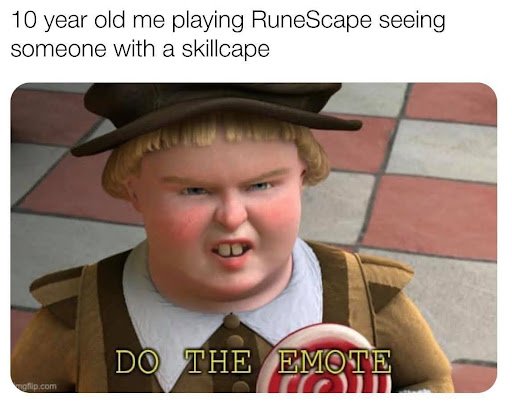
Source: u/SingofMe
Why it Works
Using the above components, OSRS magically turns what would normally be considered low-effort filler into content that hundreds of thousands of players enjoy.
This magic trick is so effective that I wouldn’t be surprised if the developers of Runescape spent 10x less per hour of playtime than every other developer out there.
To understand why this is the case, let’s go through the unique feelings that define the OSRS progression system and break down how they’re created:
“My progress means something”
One of the primary differences between OSRS and other MMOs is that, in OSRS, just getting skills to 99 or doing everything to “complete” your account is the long-term goal for most players.
By comparison, other MMOs rely on a constant stream of new endgame PVE content to keep players interested, which costs a lot of money to develop.
OSRS has that too, but it was only added recently and so the game clearly didn’t need it to succeed.
Now there are two reasons why OSRS can attract players with just completion alone:
You can fully complete objectives to get a satisfying feeling of closure
And there’s no aggressive monetization that would cheapen the value of completed objectives.
1. Completable Objectives
Let’s start with the idea of fully completing objectives. OSRS has a different way of retaining players than most other MMOs: it uses exponentially scaling requirements for a finite set of objectives, rather than linearly scaling requirements for a near-infinite set of objectives.
Here’s what I mean: the max skill level in OSRS has been 99 since launch. The developers will likely never raise the max level or, if they do, it will happen incredibly rarely. Players are kept playing not by constant level cap raises, but by the simple fact that it just takes a really long time to reach 99.
If you do manage to get 99 in everything, you’re pretty much done with the game. If you want more after that, you can go onto making challenge accounts, like a Hardcore Ironman (can’t trade, loses hardcore status on death), or participate in seasonal challenges, like a quest speedrunning mode with faster experience rates.
The fact that you know that 99 will always be the level cap makes achieving it feel much more meaningful than max level in other games. It feels like a permanent achievement that will never be taken from you. And because it feels so meaningful, you can get players to click pixels for 150 hours just to see the number 99.
This is all enabled by the fact that the experience required to level up scales exponentially as you progress from 1-99. You’ll need about 10% more experience per level, so your journey from 1-92 takes about as much experience as 92-99.
This means that a 99 will take around 50-150 hours, even if you know what you’re doing. And, with 23 skills in total, that’s already quite a bit of playtime to go through.
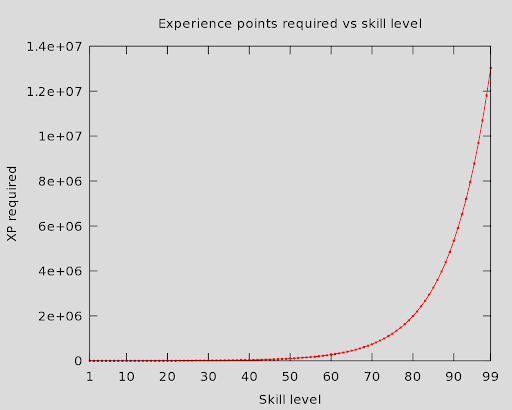
Experience required per skill level. Source: OSRS Wiki
But who on earth is bothered to get 99 when the journey there is so blatantly padded out with exponentially increasing experience requirements?
The answer is a lot of players, thanks to this sense of being able to permanently complete a 99, plus the system cleverly exploiting sunk-cost and the way we process numbers.
It doesn’t take long to get to level 70, for example. 70 doesn’t feel that far away from 99, it’s more than half of 99, right? Then you get to 80. Again, 80 seems like it's not that far from 99. After a bunch more grinding, you get to 90.
At this point, you’ve spent so much time that you might as well get the 99. And there are “only” 9 levels left, right? Of course, you’re not even half-way there yet, but you’re much less likely to quit the grind because you’re so invested at this point and the 1-99 scale is misleading you.
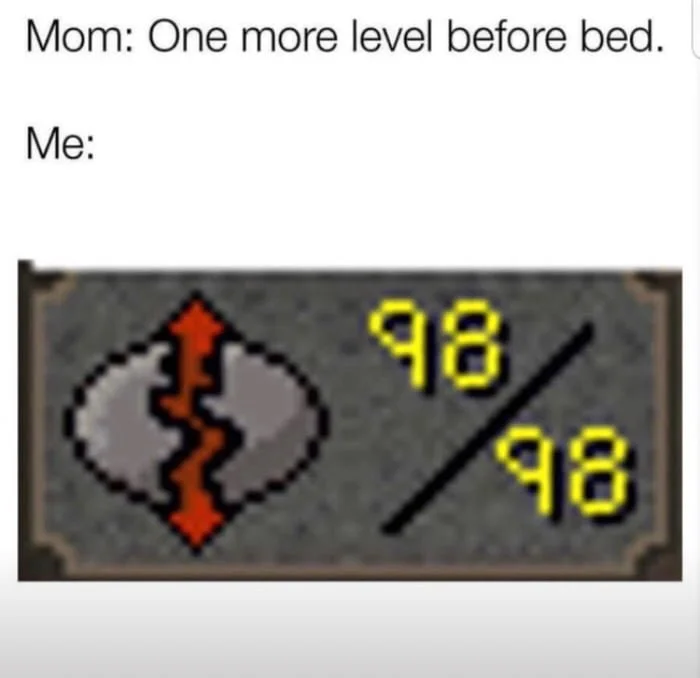
98 to 99 Runecrafting takes around 50 hours.
This philosophy of long but finite grinds also extends to other major elements like quests.
OSRS has 157 quests as of September 2023 and you can complete all of them within half a year of casual play (the bottleneck being skill level requirements). And because there are relatively few of them, they feel completable and can each be rewarding enough to serve as major objectives to motivate the player.
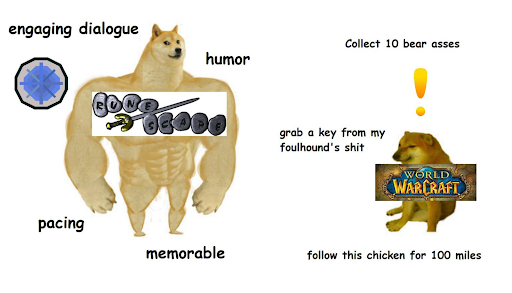
Contrast this to World of Warcraft (WoW) with its perpetually increasing level cap and 34,000+ quests. Nobody is going to get max level just for the sake of it, when they know the level cap will just increase next expansion (they’ll instead do it to access endgame content).
And completing all 34,000 quests is such an absurd task that it’s not going to become an objective for anyone other than the 0.001% of most enthusiastic questers.
WoW is a fantastic game, but it has to rely on things other than the desire to complete things to carry its gameplay.
Source: Reddit
2. Limited Monetization
The second major design choice that contributes to the feeling of meaningful progress is monetization strategy.
OSRS has no cash shop, you just pay a subscription to unlock more of the game’s content. You can buy gold with real money using Old School Bonds, but no amount of gold will let you skip past most grinds in the game.
So when you reach level 99 in a skill, you get a sick skillcape to show off and it feels even more meaningful because there aren’t any experience or level boosts that would invalidate that effort. It takes hard work (or at least taking a risk to bot your way there) and everyone who sees your skillcape knows that too.
There’s also no cosmetic shop that would flood the game with hundreds of colorful animated capes that anyone can get if they just pay up. In OSRS, looking cool is limited to those who put in the work, which makes putting in that work feel much more appealing than in most other games.
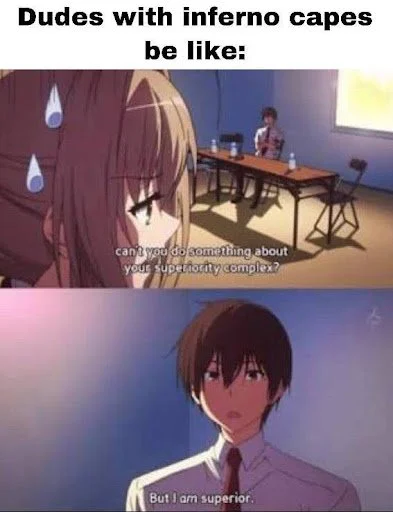
When you get the Infernal Cape, for example, everyone knows that you went through hundreds of hours of grinding to challenge the boss and then proved your skills by taking them down (unless you got someone else to play on your account).
There’s no Infernal Cape recolor on the cash shop or cooler animated cape that would dilute its value. If you look cool, you are cool. And we all like being cool.
Source: u/ucncalmemom
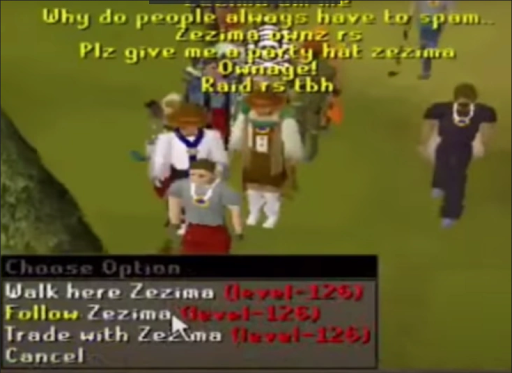
To illustrate just how effective OSRS is at creating social status: the rank 1 player from 2004-2007, Zezima, became so famous that he’d instantly get spammed with hundreds of messages and pull everyone in the area into a conga line the moment he logged in.
Everyone knew and still knows Zezima. That’s despite the game not being all that competitive (at the time) and Zezima having no desire to interact with fans or build a following.
Just the leaderboard spot, and the ungodly commitment it represented was enough to seem like the coolest guy on earth to the entire western world’s population of 10 year olds.
Source: u/Ir0nstag
That being said, not having any form of paid cosmetics or convenience items also means that the game doesn’t really earn that much revenue for how many players it has.
It’s earned about $70-75 mil per year over the past few years with an estimated 1.5 million daily active players. That revenue figure puts it roughly on par with the more modern, monetization-heavy Runescape 3, which has about 4x less players.
So, while progress does feel more valuable because of OSRS skips out on most forms of monetization, the trade-off is that you’re not going to have the same amount of resources to hire people and pump out content that would add even more value to progression.
Or so the theory goes, because, in reality, coordinating development and maintaining quality in a videogame gets harder and harder with a bigger development team. More money and more people doesn’t automatically make a game better.
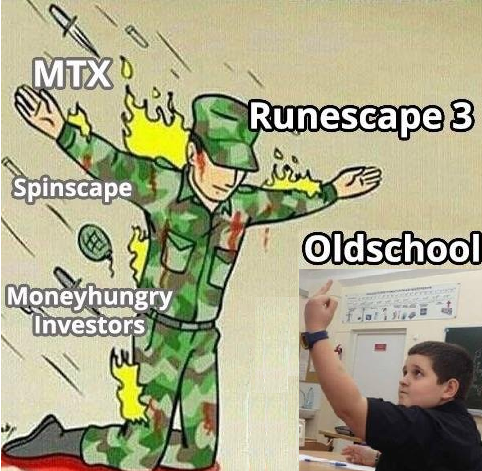
There’s a reason why the more modern version has far less players (and is rapidly declining), despite having a much bigger team, far more resources, and all sorts of modern monetization tactics.
Source: r/Runescape
“Everything I do matters”
Another critical component of the Runescape puzzle is how it manages to make players feel like everything they do matters.
There are a few reasons for this:
There’s a huge number of checklists that grant unique rewards for doing pretty much anything in the game, and these rewards tie into all other systems in a way that feels incredibly valuable
The well-balanced player-driven economy maintains the value of items gained from grinding pretty much any activity
Items often have niche utility and both items and enemies scale linearly, so items gained from lower level enemies are still useful 500 hours later and older content doesn’t feel like a waste of time
1. Checklist Galore
In OSRS, it’s difficult to do anything that doesn’t directly contribute to some kind of checklist on your way towards account completion. This is thanks to the combination of quests, achievement diaries, and a skill system where you earn experience from doing the skill. The result is that everything you do feels valuable.
As an example, let’s say I randomly decide to go level up Woodcutting because I want to chill while watching Netflix on my other monitor.
Not only will that earn me resources that I can use elsewhere and get me closer to 99 Woodcutting, it’ll contribute to like 48 different quest and achievement diary requirements that require a higher Woodcutting level.
Those quests and achievement diareis will then unlock all sorts of future content and make other grinds easier, which feels immensely satisfying.
To show just how far this philosophy goes, let’s consider the example of basic monster slaying.
Killing enemies already contributes to your combat skills and earns you money. That’s enough for most games, but not OSRS. OSRS also ties killing enemies to a bunch of other checklists and even a full-fledged skill: Slayer.
The way Slayer works is that you go to a Slayer Master, get a task like “kill 50 blue dragons”, and get to work. Once you’ve killed 50, you can go back to the Slayer Master, turn your task in for some slayer points and get the next task.
You can then use those points to:
Unlock new tasks
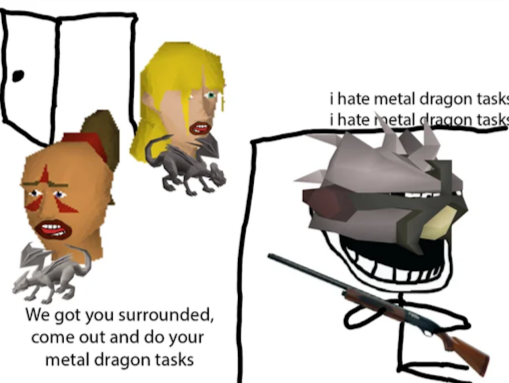
Block certain tasks (if you don’t want to fight, say, metal dragons)
Extend the tasks you do like
Buy useful items that you can only get from Slayer
Or make future Slayer tasks more convenient with perks (like preventing you from having to manually click on enemies with an item to finish them off).
There’s even a streak system that gives you a huge chunk of extra points for every 10, 25, 50, 100, and 1000 tasks completed, just in case completing tasks didn’t already feel rewarding enough.
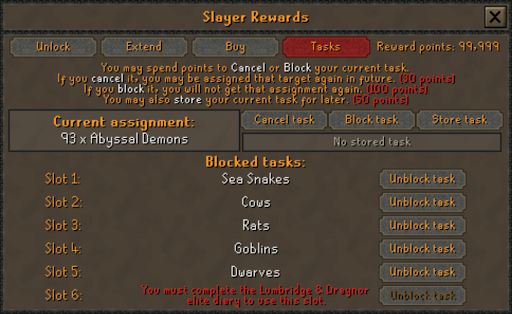
The Slayer task UI. Source: OSRS Wiki
Players absolutely love Slayer, even though “go kill x monsters” is considered boring, low-effort content in every other game. The extra objectives and massive feeling of stacking value changes everything.
As a side note, Slayer wouldn’t work if tasks didn’t take a long time (>10 minutes) to complete.
If tasks were quick, they wouldn’t be able to grant big enough bursts of reward to really feel valuable. The player would also be spending more time running around the map instead of doing the fun part (i.e., killing enemies).
I say this because other MMOs like Final Fantasy 14 and New World get this wrong. They have kill quests that are completed in less than a minute, which makes you feel more like a delivery man than an adventurer.
Source: u/GunnarVonPontius
But Slayer is just one example of broader checklist galore. Another is how you have some servers that are only accessible for those above a certain total skill level.
That doesn’t sound too important, but getting to play on those servers becomes an objective for many players, since you know they’ll have less competition for scarce resource spawns.
But of course the checklists don’t end there, you also have:
The Costume Room, with a spot for every item in the game
A pet list, which lists all 56 pets and shows you how many of them you’ve collected
A boss kill count leaderboard
A separate achievement diary for killing bosses, which involves tasks like “kill this boss without taking damage” or “kill this boss in under 6 minutes and 30 seconds”
And a Collection Log, which shows you all the items have and haven’t received from every activity in the game.
Because of those checklists, you’re now justified in killing some random low gold/hour boss because they drop items or a pet that you’ll need for true account completion. They add just a bit more value to everything you do in the game.
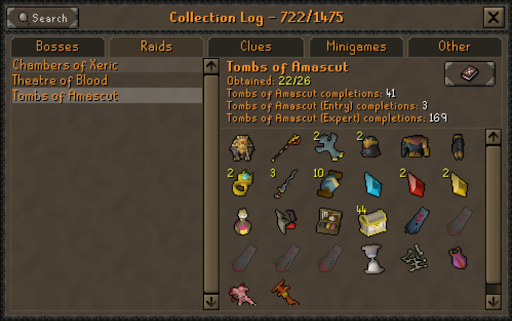
The Collection Log. Source: OSRS Wiki
The really critical element with all these objectives, though, is that they’re heavily tied to all other systems in the game in a way that makes them feel even more ridiculously valuable.
Let’s take Agility as an example. As you train it, you unlock:
Shortcuts to get around the map faster
Access to new areas of the map
Higher stamina for running long distances
A (very important) item set that reduces stamina consumption from running
All sorts of quest and achievement diary requirements
And, eventually, the Agility skillcape that you can show off on your way to maxing your account
Nobody would ever touch Agility (or many of the other activities in the game) if they didn’t come with all these rewards that feel great because they unlock so many unique things that are useful for your future progress.
If Agility rewarded players with just experience and gold (like most activities in other MMOs), then players would never do it unless it gave much higher exp/gold rates than other activities. The fact that rewards are unique stops players from treating them like random filler on their way to the endgame.
Source: u/eatmyass2049
A similar list of unlocks applies to most quests, achievement diaries, and skills. The fact they provide useful, unique rewards prevents them from competing against each other and ensures that all content feels valuable.
This is great because it makes everything you do feel like a good idea. And the sheer amount of options means that players will start spending their time away from the game planning out what they’ll do the next time they log in, which is fantastic for retaining players.
Players might even plan together with a friend, so that they start hyping each other up for the moment that they can access a raid and start learning it together. They’ll share guide videos and talk about what roles they’ll specialize into, among other things.
And OSRS’ vast number of objectives means that, if one friend has more free time than the other, they can go and do some other grinds while they wait for their friend.
That’s a huge issue in other MMOs, where there’s only one way to progress so you either don’t play the game to wait for your friend or then play and leave them behind.
Then, once players do get to the next session they planned, they’ll have so many enticing options that they’ll probably end up getting distracted and doing whatever they feel like anyways. It’s a great feeling to be able to do whatever you want to do and still make progress.
I would highly recommend watching this amazing video by Marstead, that’s where I got the last three points from and he does a much better job explaining them in detail.
2. Player-Driven Economy
Another reason why doing anything in OSRS feels valuable is that every item in the game can be exchanged for currency. When I go to chop those logs, I can sell those logs for money, even if I already have 99 Fletching and don’t have any use for them myself.
That way, everything I do feels rewarding even if it isn’t directly tied to any quest or achievement diary. Plus, I can personalize my experience by doing activities I want to do and using the gold I earn to skip past other activities.
But, if I do want to do everything and feel the unique sense of accomplishment that comes with that, I can create an Ironman account that can’t trade.
Very, very critically, this feeling of reward and personalization only works if item value is held up by a well-designed and well-balanced economy.
To achieve this, OSRS has a crapload of ways to get rid of currency in the game, so that inflation doesn’t ruin the value of items over time:
A 1% tax on every Grand Exchange (auction house) transaction
The entire Construction skill, which just involves converting gold into furniture for experience and flex value
Full-loot PVP with items that disappear if not picked up after a while
Fees that you need to pay to get to some high-reward areas
A fee to pay to get your items back after dying to a boss
A stamina system where you can only run for a while before going out of stamina, which forces you to chug potions to refill your stamina
Consumable teleports that get you to places faster
Toll fees to get to some places on the map
A combat system that consumes potions, food, runes, and ranged ammo to perpetually create demand for them
Some items that have to be repaired or recharged for a gold, resource, or item cost (Crystal Bow, the Barrows sets, Abyssal Tentacle, etc.)
The Old School Bond, which you can buy to convert gold into game subscription time (instead of paying $12/mo)
Extra bank space that can be bought for gold
Occasional donation events where the developers donate money for every x gold donated by players.
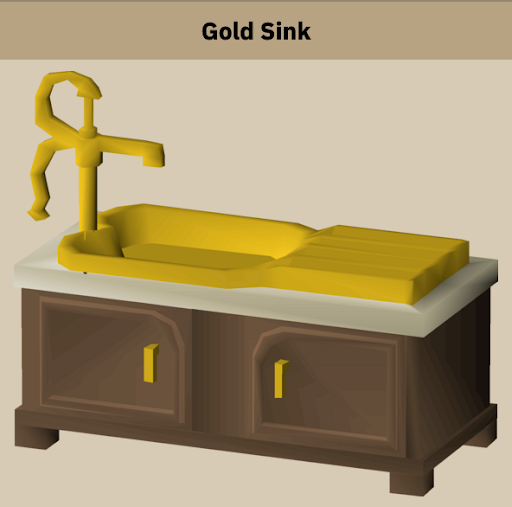
The Gold Sink is a useless gold sink that costs 100mil gold. You build it to flex on people visiting your house. Source: OSRS Wiki
It’s also important that there are two price floors for every item: an NPC vendor price and a High Alchemy price (High Alchemy is a spell that converts any item into some amount of gold).
This artificially maintains the value of items that don’t have as much demand for whatever reason. In other words, even if nobody will want the item you just got from killing an enemy, you can still cast High Alchemy on it to get a reasonable chunk of money.
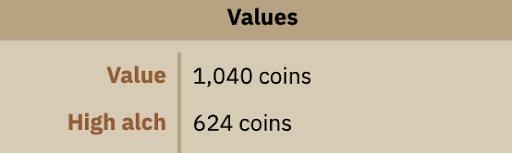
The High Alchemy value of a Mithril Scimitar. The vendor purchase price is somewhere between 0.1-0.6x that “value” figure, depending on which store you sell to. Source: OSRS Wiki
These solutions aren’t perfect. OSRS still has quite a bit of inflation, especially whenever there’s a surge of bots that disproportionately flood the market with items from all the activities with low entry barriers. But it’s in a better place than most games where the economy plays a large role.
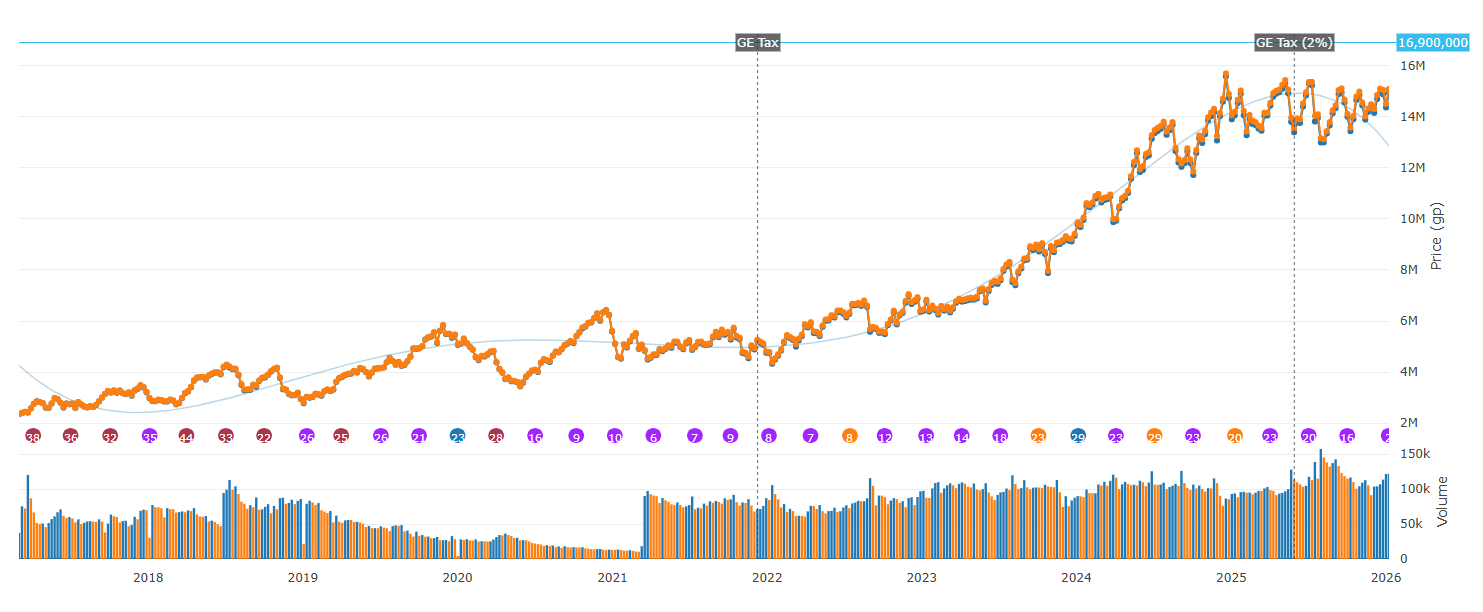
Although it’s shot up over recent years, the price of Old School Bonds (a proxy for inflation) grew at roughly 19% per year between March 2017 to March 2023. That’s not much for an MMO. Source: GE Tracker
3. Item Scaling and Niche Utility
The last critical component of the “everything I do matters” feeling is how the game handles item and enemy scaling.
For a bit of context, most other MMOs scale item and enemy stats exponentially. In WoW, for example, players go from dealing 10 damage per second at level 10 to over 100,000 at level 70.
And, every time there’s a new expansion, new gear has much better stats than the previous expansion’s gear. So all old gear is instantly rendered obsolete when a new expansion is released (for anything other than cosmetic purposes).
This even happens during content patches in between expansions, since every major patch adds new gear with higher stats. Plus, the developers always add catch-up mechanics that let new players skip old content to experience the new content with minimal delay.
This is fine for WoW, since getting an upgrade or the best-in-slot item for that patch still feels great. But it means that old gear just gets invalidated constantly, so there’s less content for a new player starting from scratch and everything other than endgame content feels like a waste of time.
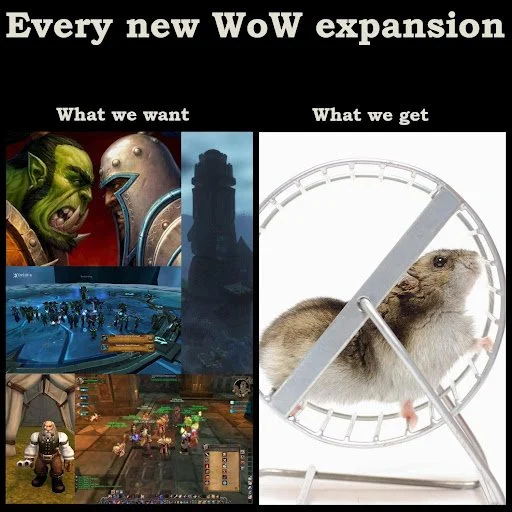
WoW’s item level hamster wheel or “gear treadmill”. Source: u/Diproc
In OSRS, on the other hand, items scale linearly. If you have 99 Strength and are wearing no other items, your maximum hit with a Mithril Scimitar is 14. A Mithril Scimitar requires level 20 Attack and costs 380 gold, for context.
An Abyssal Whip, by contrast, requires 70 Attack and costs 1.4 million gold. But it only raises your max hit to 24. You’re paying 3600x more gold for just 10 more in max hits (and this gets much more extreme for actual best-in-slot items).
This means there are a smaller number of gear upgrades overall but, when you do get a best-in-slot drop, it feels valuable because you know you won’t just throw it away in 3 minutes when you get a better item.
In other words, OSRS discovered that you don’t need to raise an item’s stats by an order of magnitude to motivate players to get it. That’s just a needless source of content invalidation and balance issues. For whatever reason, nobody else has learned this.
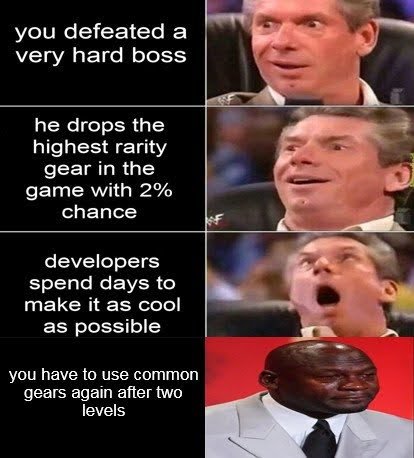
Source: u/AshenVR
The same linearity also applies to enemy stat scaling. The King Black Dragon, which came out in 2002, has 240 Hitpoints, 240 Defence, and +90 Defence bonus against slash attacks.
Vorkath, which came out 10 years later (when we take into account the 2007 rollback), has 750 Hitpoints, 214 Defence, and +108 Defence bonus against slash attacks.
That’s not a whole lot of difference, which makes it so that older bosses still pose a challenge and force you to consume food and potions. They don’t feel like a waste of time like they do in every other MMO.
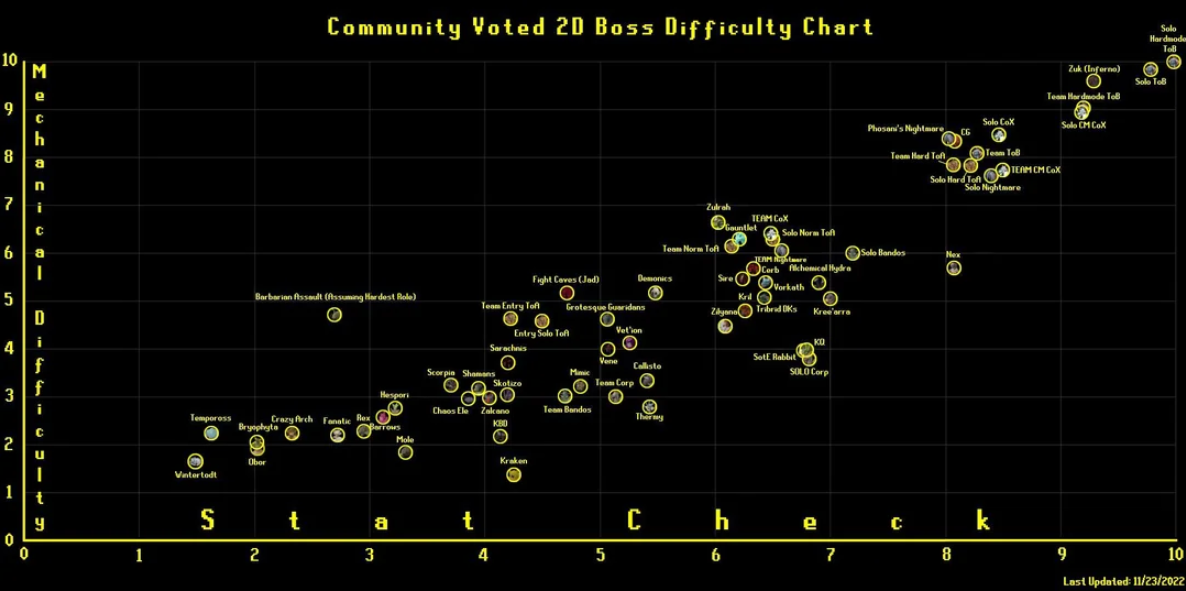
Bosses by mechanical difficulty and stat requirements as voted by r/2007scape. Shows how old bosses still feel like content. Source: u/FalcosLiteralyHitler
Another important factor behind the longevity of content is how items have unique combat and non-combat effects, which keeps the items (and the bosses that drop them) meaningful over time.
Here are a few examples:
Unique special attacks
The Dragon Warhammer has a special attack that reduces the enemy’s defenses. This makes it one of the most useful items for killing bosses, even though it only requires level 60 Attack and has existed in the game since 2016.
In general, a lot of items have special attacks with niche use cases, like restoring health and Prayer points, hitting more targets in an area of effect, or ignoring the usual delay between special attacks (so that you can do a special attack combo).
Attack, defence, and enemy types
OSRS has several different attack styles (stab, slash, crush, ranged, magic) and enemies and players have a defensive stat for each of these styles. This means that new best-in-slot items only invalidate the old items that were previously best-in-slot for that particular style. Attack styles functionally let the developers release 5x more items without invalidating old items.
One example of this is the Warrior Helm. It’s roughly 40k gold and only requires 45 Defence (plus completing a quest), yet it still provides the highest slash bonus in the game (at the cost of not providing many defensive bonuses). That means it’s still useful for fighting enemies that are weak to slash attacks and don’t pose much of a threat.
There are also some items that are uniquely good against particular enemy types, either by protecting you from their most powerful attacks (like the Anti-Dragon Shield) or letting you deal more damage to them specifically (the Leaf-Bladed Battleaxe).
Bosses can have multiple phases where they swap which combat style they’re weak to. So you might even have to use three item sets (melee, ranged, and magic) to take them down. Then they’ll be weak to particular types of melee attack, for example, and particular bow and staff variants with unique effects, so the best-in-slot items change from boss to boss. That means items remain viable for so much longer than in any other game.
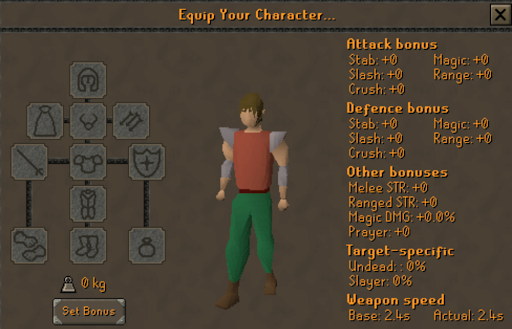
The equipment stats window. Source: OSRS Wiki
Non-combat utility
There are also item sets that provide bonuses to non-combat skills, like the Angler’s Outfit for
Fishing or Rogue Equipment for Thieving. This is another way that the game maintains the gameplay value of old minigames, since those are often the only way to get these items.
Then there are items that let you teleport to a unique location (like the Ring of Dueling), protect you from the heat when in a desert (desert clothing), and even an item that conveniently converts some dropped items in a particular region into a stackable form (Amulet of Avarice).
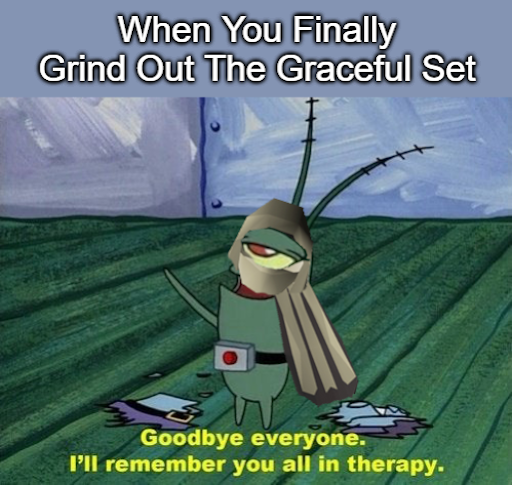
The Graceful Outfit is one of the main reasons why people train Agility. OSRS is all about running around the map, so being able to do so for longer feels like a huge upgrade.
Crafting requirements
Newer, more powerful items are sometimes crafted by combining an old item with a unique item from a boss or minigame. Those old items remain valuable as a result.
One example is Eternal Boots, which are the best-in-slot magic boots. These are created by combining Infinity Boots (an older item from the Mage Training Arena minigame) and an Eternal Crystal, which is dropped by a newer boss. This ensures that grinding the Mage Training Arena still feels somewhat useful, even though it was released in 2006.
So, when you have items that stay relevant even after 500 hours of play and there are no catch-up mechanics (other than seasonal servers where everyone starts from scratch), your grinds feel like they matter even if you’re spending most of your time doing content from 10 years ago.
This adds tremendously to the cost-effectiveness of development and the overall longevity of the game, which is something that other MMOs struggle with as they continuously invalidate old content with new releases.
Plus, it prevents new players from feeling like there’s a huge chasm that they have to overcome before the “real” game starts in the endgame.
Final Fantasy 14 “gets good” after the first 50 hours and WoW gets good after the first 15. In OSRS, the game “gets good” from the moment you create your account.
“There’s always another objective close by”
One of the hallmarks of a great progression system is that it keeps the time between completed objectives low enough to keep you engaged, but high enough to extend playtime and make completing them feel meaningful.
And, if we really want to hook players, there should always be another, preferably partially complete, objective close by. That way, it’s hard to justify stopping at any point.
There are two ways that OSRS accomplishes this (most of the time):
There are an extensive series of meaningful objectives that can are completed at different time scales, so you’re bound to have at least one objective you can complete within 30 minutes
Rewards for activities and objectives that overlap with the requirements of other objectives, so that you’re always at least part of the way to whatever new objective you start
1. A Crapload of Objectives
Because OSRS has such a long list of objectives that feel meaningful, there’s usually at least one or two that are within 30 minutes of playtime, so that you get the “let me just finish this before I head off…ok I’ll finish this too but this is the last one, I swear…jesus christ it’s 4 am, I gotta go sleep” effect.
One of the contributing factors is that obvious objectives like quests, bosses, and achievement diaries aren’t the only ones that feel meaningful.
As one example, the next tier of tool/weapon/armour is an objective in OSRS in a way that it isn’t in other games. That’s because items:
Have static (as opposed to randomized) stats, so that there’s no moment of “damn, I got the item but the rolls suck” that would dilute their value as objectives
Drop from a defined list of enemies, are achieved from a defined set of tasks, or can be bought from other players. This means you can set items as objectives to grind for, rather than having to just get lucky from a completely random drop that you can’t plan for.
And are unlocked every 10 or so levels in the relevant skill, so that they can feel like big enough jumps in progression to become objectives. This wouldn’t happen if the upgrade rate was significantly faster (unless you broke the linear stat scaling model and went with exponential instead).
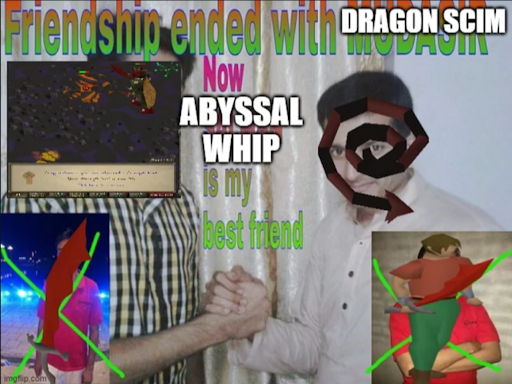
Source: u/Sneakysnakethesnake
Another source of objectives is really stupid, but it works: showing all the player’s skill levels in a UI tab that you can look at as you’re grinding a skill, with the ability to hover over a level to see how much experience you need for the next one.
This makes it so that players automatically start creating objectives for themselves because of a desire to create satisfying numbers: “I’m so close to 60…I almost have everything above 50…what if I got 66 in every skill?”.
Things like getting a skill to some factor of 5 or getting every number to be the same motivate players way more than they should. And, just like with your LinkedIn page, it gives you a thing to constantly stare at to admire your progress.
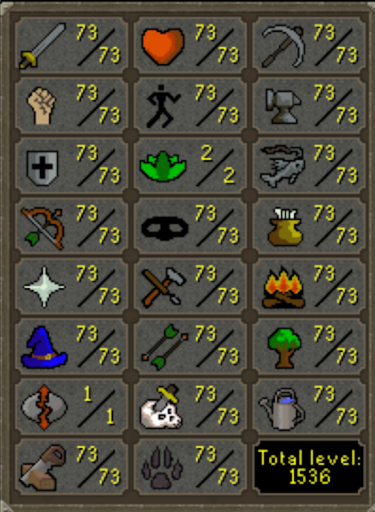
The skills tab in OSRS. See how it creates two very clear objectives with just numbers? Source: OSRS Wiki
Then you have objectives that are tied to in-game timers. The Farming skill, for example, involves planting seeds into farming patches found around the map and then going to do something else while the crops grow. Birdhouses for the Hunter skill and the Miscellania kingdom management minigame are other examples.
There aren’t many of these time-gated tasks, but when the player chooses to engage with them, it basically ensures that players always have at least something they can complete at least every once in a while even if they’re focused on a long grind with few milestones in between. That wouldn’t be the case if every task in the game only delivered rewards for active participation.
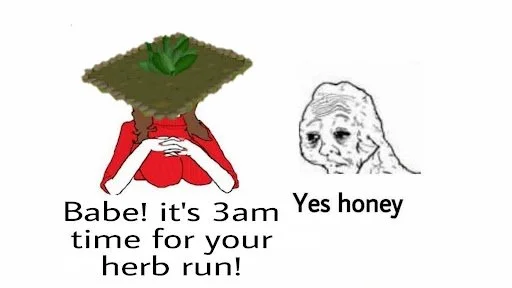
Source: u/DeadKitten23
Once you combine all of these objectives, your brain will keep making excuses to play more even though you know clicking pixels is a waste of time: “I’m almost at the next level of mining, let’s get that before I go to bed…just remembered I haven’t collected by Miscellania rewards yet, I’ll go do that…I’m so close to 50 Fishing, I might as well grind a few more levels…let me just finish my farm run before I stop playing”.
But there are downsides to this as well. The sheer number of objectives and choices can easily overwhelm new players and there isn’t much direction to ease players into it.
2. Objective Overlap
Another critical part of hooking the player is how all of these objectives overlap with each other, such that your next objective is often at least partially completed by the time you start it.
This is very effective at keeping us playing because of the endowed progress effect: if we’re already part of the way there, it feels like there’s less work left and we’re more motivated to start it. That’s why loyalty cards usually start with you with some bonus points towards the next loyalty tier.
In OSRS, training a skill or completing a quest will contribute to like 57 different objectives, like I mentioned before.
So, by the time you start training the next skill, you’ll probably be pretty close to the next level. And when you start grinding for the next quest or achievement diary, you’ll probably have at least a few requirements completed already. Doesn’t seem that daunting anymore, right?
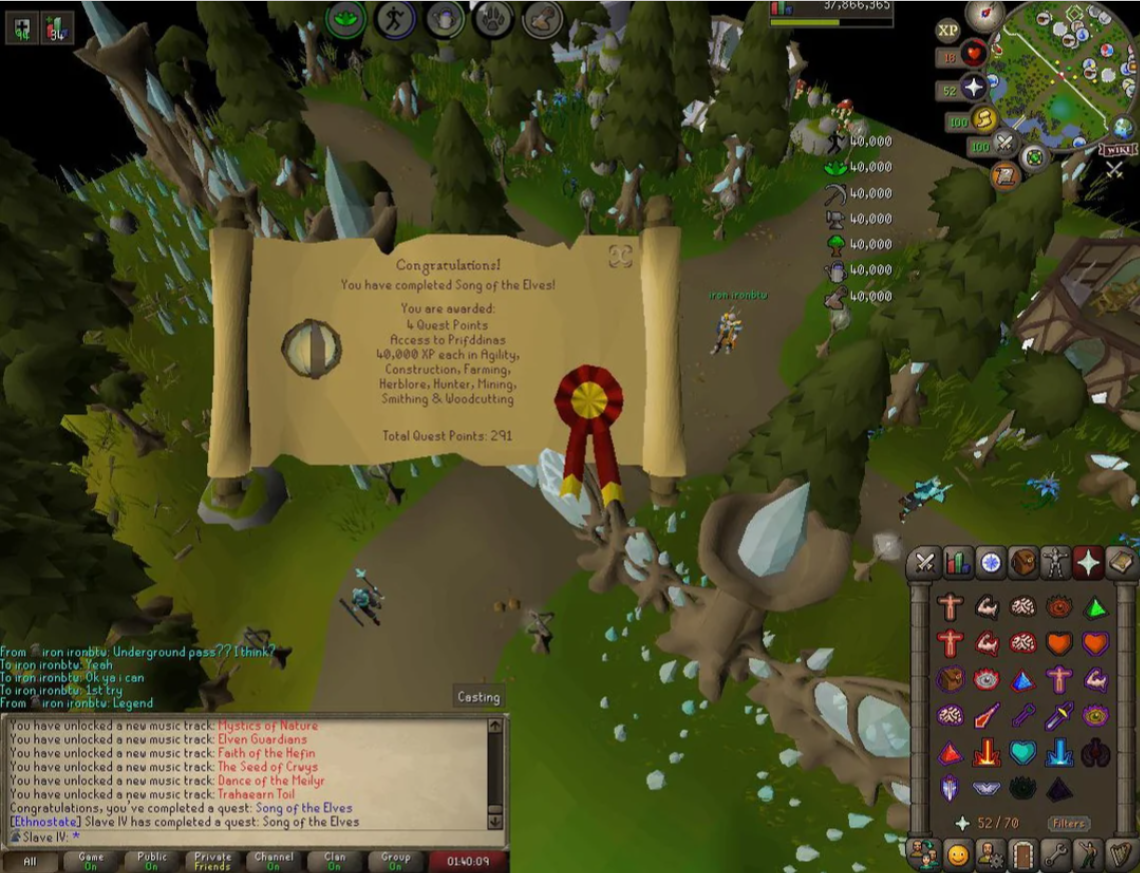
Getting a huge experience drop in several skills for completing. Look at how close the next Herblore level is (radial bar on top of image) now. You now have an easy objective. Source: u/Appropriate_Ad_8275
An extreme case of this is Slayer. When you kill enemies on a Slayer task, you’ll be doing several things at once:
Increasing your Slayer level
Getting Slayer points towards your next Slayer item
Potentially training six skills. Attack, Strength, Defence, and Hitpoints from attacking enemies. Prayer from burying their bones. And Fletching or Magic because you can fletch darts or cast High Alchemy on a stack of items during combat
And earn money towards whatever your next big item purchase (or, if you’re an Ironman, gain resources for Herblore or some other skill)
This sense of insane value is another reason why Slayer is by far the most popular skill in OSRS. And the overlap between objectives ensures that the next one is always at least partially complete.
What are the chances that, by the time you get your next Defence level, you aren’t almost done with your Slayer task, near the next Attack level and/or almost at the gold you need to buy your next item upgrade?
Setting out on your next objective is always easy, and that’s a really effective way to hook players.
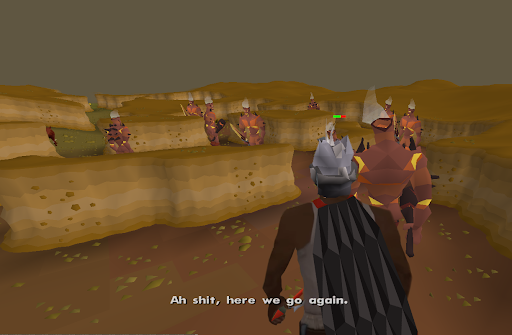
Source: u/Skyentific
This isn’t always the case for all grinds, though. You do have periods where you can go tens of hours without completing any kind of objective.
Experiencing that early on is a big quit moment for many players, since the power of sunk cost hasn’t yet kicked in.
“I can progress when and how I want to”
Another defining aspect of OSRS’ progression system is that it feels like you get to decide what to do and when to do it. And there’s always something you can do regardless of how much time you have or what mood you’re in.
These collectively make the game incredibly sticky and prevent players from burning out from what would be considered chores in other games.
There are two important factors here:
There isn’t much time-gated content that would (effectively) force players to do some fixed set of activities every day to get the best rewards
There’s a huge variety of content for every level of attention and intensity that, critically, doesn’t feel like a waste of time
1. Avoiding Time-Gating
The way that OSRS works is very different from most modern MMOs, which try to get players to come back every day with “time-gated” objectives that create a fear of missing out on progress. Daily and weekly tasks are one example.
This form of FOMO does work for some games, at least in the short-term, but it comes with a few problems:
Reactance: The moment you (even implicitly) impose tasks on players, what would normally be a “grind” becomes a “chore”. Players are much more willing to go through mediocre content if they get to choose to do it, rather than doing it because that’s what the designers chose as the most rewarding thing you can do today.
Inaction inertia: If the player misses out on an important weekly quest for whatever reason, there’s a good chance they’ll think: “Damn, now I’m behind. I missed out on so much value. Is there even a point in playing now?”. In that scenario, they’ll be much more likely to quit than if there was no weekly reward at all.
Poor personalization: Every player’s preferences for what they want to do and when changes from day to day. If game designers pick some list of activities and use FOMO to effectively force players to do them, players will be doing a lot of things they don’t actually want to do every day. That might keep players logging in for a while but, over the long-term, they’ll get burned out and might never touch the game after that.
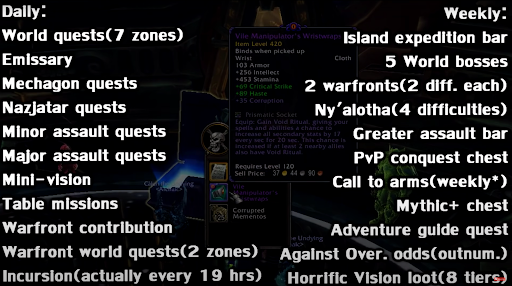
The list of useful daily and weekly quests in WoW: Battle for Azeroth. There’s no faster way of getting players to despise your game than using FOMO to pressure them into doing hours of unwanted tasks every day. Source: MadSeasonShow
The reason why OSRS doesn’t have much time-gating is that it doesn’t need it. Every other MMO needs to throttle player progress to prevent them from instantly chewing through all the new content.
But that’s not a problem for OSRS because it’s one of the only games that manages to keep old content relevant. In fact, there’s so much content that most players are still in the midgame, despite the game launching in 2013 and players having an infinite number of guides for optimal play.
Another reason is that a substantial chunk of OSRS’ content, like Agility or Mining or the Mage Training Arena, is so repetitive, unchallenging, and tedious that it’s just not fun for most players. Players only play through it because of how effective the game is at making progression feel valuable.
If the game used time-gated objectives to force players to train Agility, even less people would do it because you’d be adding more demotivation on top of something that players already struggle with. Logging in to do your Agility dailies would feel like a huge chore.
Conversely, if it used time-gating to encourage players to play only the actually good content, players would never touch Agility and you wouldn’t get the hundreds of hours of (just barely tolerable) gameplay value that Agility provides.
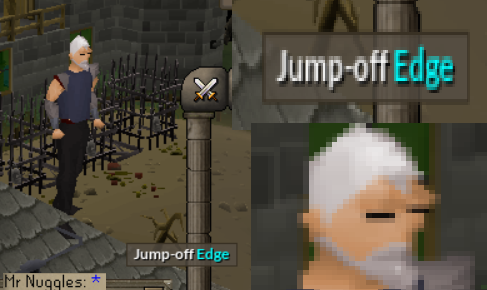
Just in case you haven’t realized how much everyone hates Agility, here’s another window into the life of a player training Agility. Source: u/KingSerenade
However, like I mentioned before, OSRS does still have some time-gated activities. Farming, bird house runs, Miscellania, and the Tears of Guthix minigame are a few examples.
For most players, these are just nice options for when you feel like doing them. But that’s only because:
They’re usually quick, taking up a very small portion of a player’s gameplay session. This is in contrast to how they’re implemented in most games, where dailies can easily siphon up all the time you have to play in a day.
They aren’t exceptionally rewarding and there’s usually an alternative way of getting whatever resources you get from them, so players generally don’t feel compelled to do them every day
They’re often tied to progress in a specific skill, like Farming or Hunter, so they don’t directly compete with most other activities in the game (other than alternative training methods for those skills). That’s in stark contrast to daily quests in other games that reward some kind of common experience or resources in a way that makes them outcompete all other activities.
They’re initiated by players, rather than by designers on a fixed daily or weekly cycle, so the loss of agency doesn’t feel as strong.
But that’s not the case for Ironman accounts, since they can’t just buy herbs or whatever else off the Grand Exchange.
If they’re training Herblore, for example, they’ll have to do a long list of daily or even hourly tasks to get the ingredients they need.
And it’s easy to get stuck in a loop of doing them every day even if you don’t really want to, since skipping the time-limited opportunity would feel like you’re wasting time.
The problem is that, in this case, there are too many time-gated tasks and they’re too important to skip, so you get the exact “after I’m done with my dailies, I’ll finally get to play the actual game” feeling that OSRS otherwise does an excellent job avoiding.
But the rest of the playerbase does get to feel like they can do what they want to do, when they want to do it.
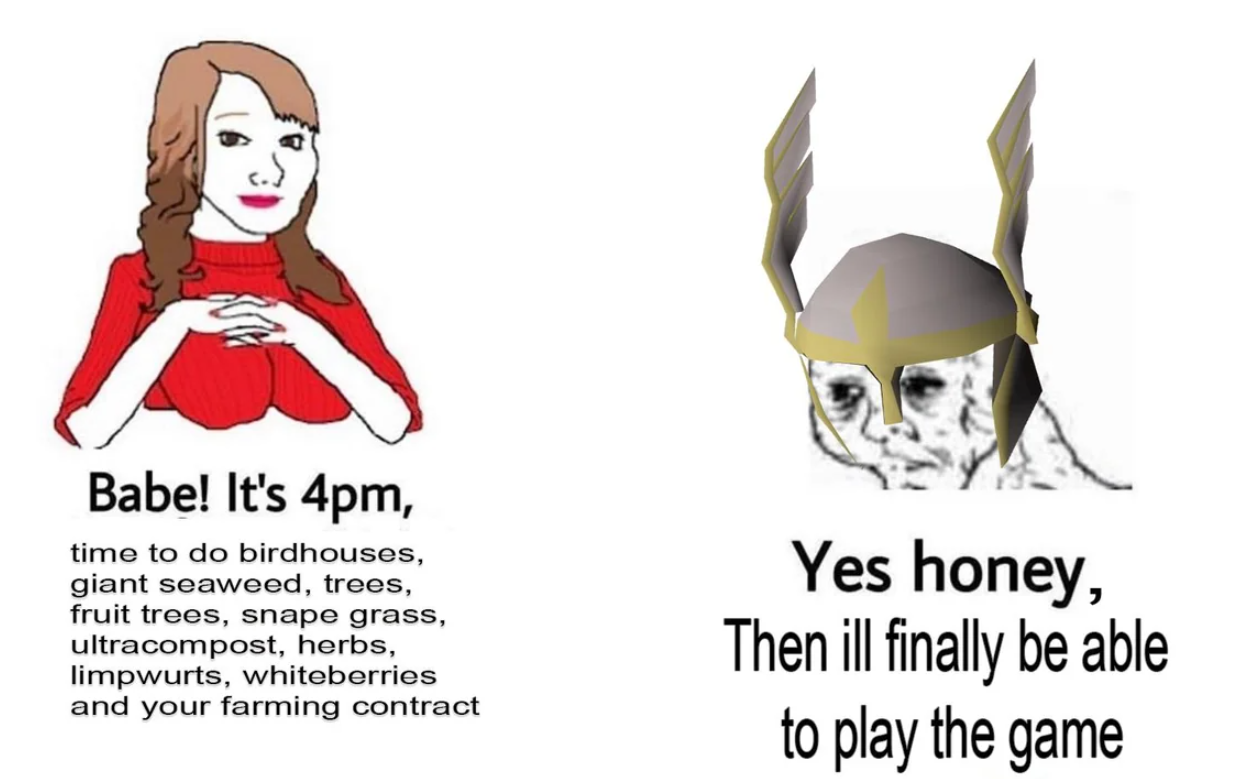
Ironman players can end up having a boatload of daily and hourly tasks that functionally remove their sense of agency. Source: u/epicgamer234
Not including time-gating does come with some negatives, though. Outside of extending the value of new content, time-gating also helps prevent hardcore players from zooming past everyone else. Everyone can only do a daily quest once regardless of how many hours they play per day, so it balances the playing field.
And that matters because, as a casual player, it can be tough to justify picking up a new game if you know there’s no chance that you’ll keep up with other players.
But, for OSRS, the top players have long since completed everything with their 20,000+ hours of playtime, so that’s not really as much of an issue as it is in other MMOs.
And there are also seasonal events where everyone starts from scratch with higher experience rates, so that anyone with a week to spare can participate in the race.
Source: u/IroncladGG
The bigger problem, though, is the whole thing about players being presented with an overwhelming list of things to do.
Some players don’t enjoy having to set their own goals every session and instead prefer the guidance and quick bursts of progression that daily or weekly tasks provide.
But that’s fine. Time-gating isn’t the only way to give players structure and direction and people that really enjoy dailies have about 100 other games that give them just that.
2. Content Variety
Another factor that contributes to the feeling of freedom that OSRS provides is that it offers a lot of different activities for any mood or time window.
You can get high-intensity thrills from full-loot PVP and difficult boss fights, you can AFK and fish while watching videos on YouTube, or you can do a wide range of activities that fall somewhere in between.
Every type of activity (like fishing, killing bosses, or doing quests) usually has a mix of more intense and less intense alternatives, depending on what you’re in the mood for.
Here are some examples:
You can train melee by literally walking away from your keyboard for 20 minutes via the Nightmare Zone, but you gain (basically) no resources. Or you can train it by killing normal enemies during Slayer tasks for more rewards.
You can train Woodcutting by clicking on a tree once every 5 minutes at Redwood trees, but you won’t get much gold or experience per hour. Or you can get triple the experience rates by exploiting a bug that involves clicking a ridiculous number of times per minute with perfect timing.
You can train Mining by killing (or, more accurately, mining) a boss called Zalcano. It’s a much more intense activity than rock-clicking and has tougher prerequisites, so it grants more experience per hour. Or you can click nodes like normal, which usually requires some intervention every 5 seconds.
You can go train Fishing in the Wilderness, a full-loot player versus player area. That’ll let you reduce the number of banking runs you need to do (which leads to more experience/resources per hour) at the cost of possibly being killed by other players and losing your stuff. Or you can train it with a chill group minigame with lower experience rates or by exploiting a super intense, click-heavy method for the best experience rates.
As I hinted above, these activities are balanced in terms of experience per hour, gold/resources per hour, risk, attention, and prerequisites, such that the more difficult and intense alternatives are more rewarding.
If this weren’t the case, it would feel pointless to do more intense activities, even if that’s what you wanted to do that day. Making them more rewarding gives players the justification they need to do what they actually wanted to do.
And it doesn’t even cost anything because people naturally expect the lazy method to be less rewarding. They’ll just do the lazy method if they don’t feel like putting in effort on a given day. In the absence of time-gating, there’s no fear of missing out on anything.
For more on how Runescape balances the game around attention, I’d again recommend watching this Marstead video.
Source: u/MoomentOSRS
But variety isn’t necessarily unique to OSRS, plenty of MMOs have options for all sorts of moods and preferences. That’s one of the defining characteristics of an MMORPG.
The difference is that all of the game’s activities feel valuable in OSRS, so they actually contribute to variety instead of just being cool things players can theoretically do but nobody does.
For example, even though WoW has decades worth of quests, minigames, battlegrounds, arenas, dungeons, raids, professions, and whatever else, all you’ll actually be doing are the few weeks worth of activities that the newest patch offers.
That’s because the game is entirely built around raising your item level to fight this patch's bosses and compete on an even playing field in PVP this season. Anything that doesn’t increase your item level feels worthless.
You’re not going to improve your gear through Fishing or doing old dungeons, so nobody’s going to waste time on it no matter how much players would enjoy a chill semi-AFK activity.
OSRS doesn’t have that problem because it, once again, gates progress behind doing every activity in the game and gives you unique rewards for completing objectives.
Sylvanas and Jailer are the major antagonists of World of Warcraft: Shadowlands. Source: u/shirsalino
As we saw earlier, OSRS also has plenty of content that requires (varying degrees of) not much attention. Much more so than other MMOs.
This is genius, since that means it doesn’t directly compete with other forms of entertainment:
WoW loses players when a hot new show or game comes out, since it often requires all of your attention. OSRS, on the other hand, is only improved when you watch a show or play a game while grinding Slayer on your second monitor.
WoW loses players when they grow up, get jobs, and no longer have time to spend 4 hours a day actively playing on their PC. OSRS loses players because of that too, but many also stay because they can hop on OSRS mobile while commuting or at a lunch break and still make meaningful progress.
Because OSRS offers so many low attention activities and maintains the value of older grinds, it’s a game that can stay part of our everyday lives for decades.
From a business perspective, that makes it a remarkably resilient cash cow that’s really hard to mess up.
And from a player’s perspective, it feels great to have a game where you can play wherever and however you want, with everything you do taking you one step closer to completing your account.
There’s a reason why the idea of everything else in real life being an “experience waste” is a popular meme for Runescape players.
Source: u/marksmansam
“The grinds feel satisfying”
The last major factor behind Runescape’s progression system is how grinding just feels satisfying. There are a few key things here:
The game often leaves room for players to optimize repetitive tasks, which partially distracts them from realizing they’re just spending hours clicking on pixels
Grinds generally require little attention or have input sequences that can be ingrained into muscle memory, so that they don’t feel tedious and you can put most of your attention elsewhere
Grinds often keep players in the same location with at least a few other players, so players can pass the time by chatting
The game’s simple art/audio style make audio-visual effects stand out, so that grinding skills and hitting enemies feels satisfying
Everything is driven by variable reinforcement, which makes basic activities exceptionally good at hooking players
1. Optimization Opportunities
The genius of store coupons is that they get customers to focus on “outsmarting” the system, which prevents customers from realizing that they’re actually spending way more than they’d be without the coupons.
A similar effect applies to grinds in OSRS. Many grinds have some way to “game the system” to get more value out of your time, although this is usually because of behavior that the developers never predicted.
For example, you can work out the most optimal route between your grind spot and the bank to feel like you’re getting maximum value. The same goes for quests when doing multiple back-to-back.
Here are a few more examples of this:
While doing a lot of High Alchemy, you can put items into the slot in your inventory that’s in the same place as the High Alchemy spell in your spells tab, so that you don’t have to move your mouse at all. You just need to spam click.
You can exploit bugs by quickly clicking items at the right interval to make gathering much faster in Hunter, Woodcutting, Fishing, and Mining.
While killing enemies, you can flick your Prayers on and off with perfect timing to still get the buffs without using up Prayer points.
While Cooking or training Prayer with an altar, you have two options. You can manually click the food/bone each time for faster expreience, or you can just select the automatic option for slower experience.
While training Prayer in the (PVP) Wilderness, you can kill yourself by drinking Zamorak Wines that spawn near to get back to the bank quicker.
You can even learn the muscle memory for dropping or banking items ultra fast, so you feel like a speed king when training gathering skills.
These methods are left in the game because they generally require more attention and therefore won’t necessarily invalidate lower attention options, since players will often accept lower gains if it means they can watch Netflix on the side.
However, not every grind in the game is optimizable like this, which is arguably a big weakness for the game.
Something like Agility would be much more manageable if there was some way or some option that let you skilfully avoid obstacles to gain more experience per hour, which would at least partially distract players from how monotonous it is.
Actually, I just checked and this does exist now. There’s a more difficult Agility minigame called Hallowed Sepulchre, which actually involves dodging (rather than clicking on) obstacles.
It just takes a long time to unlock. Plus, even if you don’t do Sepulchre, you can always just fletch darts or cast High Alchemy while going through normal Agility courses to get some Fletching/Magic experience on the side, so that’s at least something.
3-tick mining is when you click a few specific items in a specific order to gather resources faster thanks to a bug that’s now a feature. Source: u/PavementFan1
2. Options for Minimal Attention
In OSRS, there’s a very clear pattern in what skills players like and dislike: the most beloved skills (Slayer, Woodcutting, Farming, etc.) all require very little attention, while the most widely hated skills require a lot of it (Runecrafting, Agility, Mining).
The icons are Mining and Runecrafting.
The lesson here is that people will click on pixels for thousands of hours, but only if two conditions are met:
They don’t have to pay much attention
But they still have to do something every once in a while, so it feels like it’s their actions that are leading to the reward (and its not just automatic)
Like I mentioned earlier, players will use that attention for something else, like a YouTube video or Twitch stream. So you don’t actually need to create fully fledged, interesting gameplay to keep people playing.
But there’s another option, which lets you get away with gameplay that’s actually intense and interesting: making inputs predictable and therefore learnable to the point of not requiring much attention.
Even though the optimal training methods for Fishing or Woodcutting are highly click-intensive, people don’t mind them that much because they involve repeating the same sequence of clicks over and over again in a way that becomes rhythmic.
Those skills also have less intense, but still viable, training methods, so it doesn’t feel like you’re forced into click-intense gameplay.
The same goes for fighting bosses. They can be difficult and require a lot of attention the first few times, but you’ll eventually build muscle memory and learn to respond in the right way to every audio-visual cue.
Eventually, you won’t need to pay much attention at all, plus it can feel satisfying to pull off perfect fights as you gradually lower your kill time record.
The important thing here is that the inputs you need to perform are quick and learnable. Bosses don’t deviate from their strict patterns. They’re always in the same place and do the same things.
And bosses also respawn instantly, so you’re not tediously waiting around for stuff to happen or having to navigate a bunch of UI menus and loading screens. Grinding bosses is more-or-less frictionless.
To see what happens when this isn’t the case, let’s return to our friend Agility. While training Agility, the place where you need to click changes all the time.
This means that the click interval isn’t fast and predictable enough to get a rhythm going, but it’s also not slow enough to let you fully focus on something else. It’s in the painful middle ground.
The exact same applies to Runecrafting, a skill that’s hated even more than Agility. Runecrafting involves you running back and forth between the bank and an altar to turn Rune Essence into Runes.
If you use a 3rd party client, you can zoom out a huge distance to click all the way to the altar, but otherwise you’ll need to keep clicking new locations on the screen to move your character towards the altar or bank.
This requires so many unpredictable clicks per minute with no real decisionmaking or risk that many players will just sit at the altar and straight up pay other players to do the runs for them. It’s incredibly tedious.
So, in a nutshell, OSRS can have thousand-hour grinds because they don’t require much attention, but still ask you to do enough that it felt like you did something for the reward.
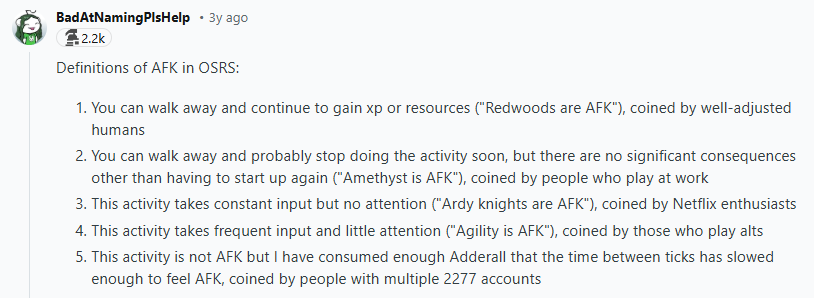
Comment by u/BadAtNamingPlsHelp from this thread.
3. Shared Spaces
One of the magical aspects of MMOs is how quickly players can form deep relationships with each other, there’s even an academic term for relationships formed this way: hypersocial relationships.
This happens because everyone gets to hide behind a player character and communicate through text, which eliminates a lot of the barriers that prevent us from interacting in real life.
If you’re, say, a 28 year old guy, you’re never going to talk to a random 14 year old kid in real life. What use could he possibly have to you? And you’d just seem like a cringey “fellow kids” old guy anyways.
If you’re a kid, on the other hand, you’re probably not going to talk to an older guy in a suit. There’s a large gap in social hierarchy and your assumption that you probably don’t have much in common with them. The same goes for people who’d love to get to know you but are afraid of speaking English.
In sum, real life can be hugely limiting when it comes to meeting new people.
Like in other games, OSRS lets you hide behind a player character and it lets you write, instead of speak (which is much easier to do fluently).
Things like your gender, age, place of birth, mother tongue, and style of dress aren’t in the way of getting to know someone, so you’re much more likely to meet people that you probably would’ve never talked to in real life.
That’s already a great start, but OSRS goes the extra mile with its grinding spots, which do a good job satisfying the conditions for building friendships: commonality, proximity, and repeat interaction.
When players train Woodcutting, for example, they’ll be in the same space for a long time, surrounded by other players going through the same grind. You might see the same player next to you 5 days in a row, doing the exact same thing as you. That’s a great icebreaker.
Neither of you has much else to do, so there’s a good chance that one of you is going to throw out the classic “wc level?” question. And that’ll start the conversation: “78, wbu?”. “72”. “Nice, are you going for max?”. “Nah just chilling while watching Netflix so I’ll just wc till I’m bored, just got back to OSRS”. “Oh which show?”.
Within 30 minutes they’ll be on your friends list, talking to you about their marital issues and life goals.
Source: u/etatirri
Not only does this add more value to what would otherwise be fairly monotonous grinds, it also creates deep social connections that can last for years.
This can keep players logging in every day just to talk with their friends, plus make progression feel much more valuable when you have friends to show it off to and compete with. Your friends might even drag you into the broader OSRS community, with all its forums and content creators, which will hook you even more.
The random characters imply a deactivated account. Source: NeevusChrist
That being said, not all grinds are great for this and there are usually a few factors behind that.
The first is competition against other players. In Mining, for example, every area only has a few ore nodes and only one player can get the ore from each node. So you’re forced to hop around servers to find an uncontested node.
It also just makes other players feel like a nuisance, which isn’t a great starting point for social interaction.
Source: Imwudyn
The second factor that hampers social interaction is the intensity of the task. Agility and Runecrafting both involve a lot of clicking and running around, so it can be hard to justify making it even more intense by typing something to other players.
Plus, you’re going to be running around, which makes it hard to have a conversation through public chat when the chat messages will fall behind as one of you runs to the next location (and you’re not going to go straight to private messages because you need to slowly escalate your relationship through public chat first).
And, lastly, having a lot of players in the same area seems like a good way to encourage social interaction, but the opposite is the case.
The more players there are, the more other players feel like a dehumanized crowd, the harder it is to repeatedly identify the same player, and the less pressure you have to start a conversation. You’re much, much more likely to chat with the person next to you if they’re the only other person there.
That’s one of the unexpected downsides of OSRS having so many bots, it creates crowds at grind spots and adds an additional layer of friction to talking to someone because there’s a good chance they’re a bot and you’ll be ignored (and feel like an idiot).
Source: u/Bennydmf
4. High Contrast Audio-Visuals
Audio-visual effects in OSRS vary in quality quite a bit. But, in general, grinds are made more satisfying by sound effects that really stand out, since they’re compressed/distorted in a way that makes them loud relative to everything else in an already plain soundscape.
It’s quite telling that people instantly recognize common sound effects, which doesn’t always happen in games with more realistic, richer soundscapes.
There’s a huge caveat, though, because some sound effects are just hilariously terrible to the point where many players turn off their game volume when around other players.
But I’m sure at least a few players would notice that something is wrong if the audio was fully remastered in a way that prevented, say, the wood chopping sound effect from standing out so much.
The same “less is more” idea applies to the few visual effects and art assets that do exist. When the game has so little visual clutter, every level up visual effect and cool piece of gear really stands out. It doesn’t get lost in the noise of shadows, reflections, and intricate detail like it does in games with a more realistic art style.
The net result is that those unlocks feel just a tiny bit more satisfying than otherwise, which quickly adds up when you’re grinding for 10,000 hours.
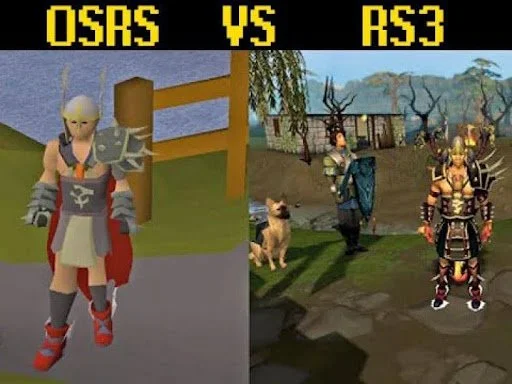
You can see how much more cool gear stands out in OSRS when you don’t have all the shadows and environmental detail to distract you. Source: u/Youngbraap
And we also get this effect with the UI. It’s much more satisfying to watch your bank/inventory stack up with items or admire your stats, when you have a simple brown background and there aren’t 500 other colorful UI elements competing for attention. Each item stands out more.
You can see how much of a difference this makes when comparing the OSRS and RS3 interface.
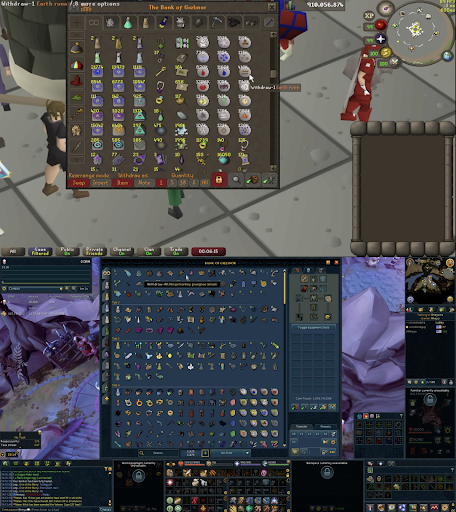
A comparison between the RS3 and OSRS bank UI. RS3 is still better than most MMOs because, while it’s incredibly cluttered, at least the items still stand out from the background.
5. Variable Reinforcement
The final important puzzle piece is found everywhere in OSRS (and other RPGs): variable reinforcement.
Variable reinforcement is when you reward only some portion of the player’s actions.
And we’re uniquely susceptible to being hooked by that, since it’s hard to justify stopping when we don’t have a good intuition for probability and we feel like we can always get lucky with the next try. This is how gambling works, and it’s how OSRS works too.
Let’s use combat as an example. When you attack an enemy with melee or ranged, you roll a number between 0 and your max hit, with the probability distribution changing according to your Attack level and item stats.
In other words, you’re basically gambling on every hit, so it can feel incredibly satisfying to get multiple big hits in a row and finish off an enemy almost instantly.
And, because you can hit 0s, you instantly notice the impact of better items. They’ll hit higher more often, even if there aren’t huge max hit differences between them, which makes each upgrade satisfying.
Getting lucky with a huge Special Attack on an enemy player. Source: Framed
Now imagine if all your attacks did the same amount of damage instead: 15…15…15…15. The standard combat loop of clicking on enemies and just watching your character attack would get boring real fast.
Throw in the possibility of getting a streak of big hits or a huge special attack and it suddenly becomes at least somewhat engaging.
Of course, this type of randomness wouldn’t work as well in a game with a more involved damage rotation that required pressing buttons. It would feel like a terrible loss of control if half your inputs ended up dealing 0 damage and there was nothing you could do about it.
It just works for OSRS because there are no buttons and basically no cooldowns when attacking (other than a global cooldown). You’re constantly auto-attacking and you can cast a spell as many times as you want until it hits, so you’ll hit eventually and missing a few hits doesn’t feel that bad.
Plus, dealing damage is closer to an idle game than an action game, so hitting a 0 doesn’t feel like you did something and failed for reasons outside your control. You never really expected to have control in the first place.
The player instead mostly controls things like their Prayer (cycling between an anti-melee, anti-ranged, and anti-mage buff according to what the enemy is attacking you with) and worn items (swapping between melee, ranged, and mage items to attack with what the enemy isn’t Praying against).
Critically, these don’t have any randomness attached to them, so the player still gets to feel like they can control things (you can’t randomly miss an item switch).
Clicking the right prayer at the right time is a key part of boss fights.
This idea of variable reinforcement also extends to gathering and production skills: when the player chops logs or catches fish, they roll a dice for how fast each resource is gathered. So, when you’re fishing lobsters, it might take you 4 seconds to get the first one and 1 second to get the next one.
If that happened at a fixed rate instead, you wouldn’t get the anticipation and satisfaction that comes with getting a streak of quick catches to immediately fill up your inventory.
Note that this effect can only happen because OSRS has a very small inventory size and relies on going back and forth between a bank to satisfyingly build up a huge stack of whatever you’re grinding. Without the inventory limit, getting several catches in a row wouldn’t feel as satisfying.
Even production skills work based on variable reinforcement. In Cooking, for instance, you have some chance to burn the piece of food (and not gain experience) depending on your level. So you constantly anticipate that moment where you successfully cook multiple in a row or even an entire inventory.
And for Farming, you roll a dice on how many herbs (and experience points) you get on any given harvest, so you start looking forward to the big harvests that can get you straight to the next Farming level. These would be far less effective if the reward was the same each time.
They’re burnt.
Then, lastly, you have item drops. Drop rates are very low for the best items. Thanks to this artificial scarcity, they seem more valuable and desired even if they’re not orders of magnitude better than the next best item.
And the developers can get away with it because we drastically overestimate the likelihood of low probability outcomes (like winning the lottery) and so continually feel like the next kill might be the one…for 500 kills straight.
If rare items dropped significantly more often from enemies, OSRS would get much less playtime out of players and these players wouldn’t be that much happier for it. We’re remarkably resilient to games with unfair odds and those unfair odds can make winning that much more appealing.
Source: u/SkizzSlinga
Then there’s also the fact that most bosses only take a few minutes to kill and, like I mentioned earlier, their patterns can be memorized to the point of gameplay becoming rhythmic. So 500 kills doesn’t feel quite as bad as if you had to repeat a 30 minute dungeon in WoW 100 times.
With so many short encounters, it feels satisfying to gradually get better at the mechanics to clear them faster and get more kills per inventory of food/potions.
Once again, though, it’s critical that this randomness is in the right place. If all enemies could drop the same items and there was no way for you to influence your chances of getting a specific one, then item grinds no longer serve as long-term objectives.
That would collapse part of the progression system, which is what happened when, for one expansion, WoW handed out the best gear from random lootboxes instead of specific raids and dungeons. Players no longer had as many objectives to motivate their gameplay.
In a Nutshell
Most activities in the game feature variable reinforcement and don’t take up much attention, which makes them endlessly grindable.
And completable, uniquely rewarding, and tightly coupled objectives make every one of these activities feel valuable, with none of the monetization or time-gating that devalues them in other games.
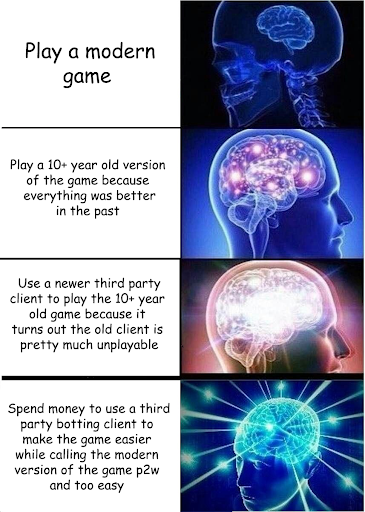
How insanely effective must a progression system be if players pay money to not play a 20 year old game? Source: u/Le_epic_meme_guy
A Quick Case Study: Why New World Didn’t Hook Like Runescape
Weirdly few games have tried to copy Runescape’s progression system. The only big game I can think of is Amazon’s New World, with its 1-200 skill system taken straight from Runescape.
Long story short, it didn’t go very well. New World’s player numbers have tanked by 95% since launch and that’s not something that happens if you manage to pull off Runescape’s progression system. So what went wrong?
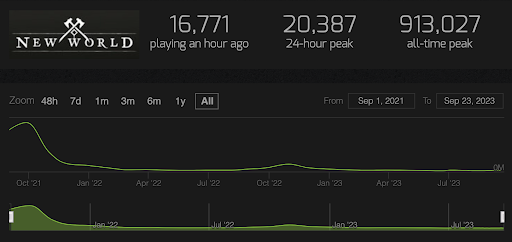
Steam player numbers for New World. Source: SteamCharts
I’ll skip the explanation of how New World works, because I think it’s possible to illustrate my points without that, so let’s just go through all the things that make OSRS work and see how New World compares:
1. Progress feels valuable because objectives are completable.
Just like OSRS, New World has kept skill level caps at 200.
But experience requirements don’t scale exponentially, so getting to max skill level doesn’t feel like an accomplishment and the game doesn’t get much long term value out of skills. In fact, level 175-200 is way faster than 100-125, so it doesn’t take advantage of sunk cost and puts the grind in the exact place where it should be (i.e., where the player isn’t as invested).
It’s easy to max your overall character level and this is raised with every new expansion, so old content is continually invalidated and the pure act of getting max level doesn’t become a long-term objective for players.
There are thousands of quests and many of them can be done more than once, so they don’t feel completable. Nobody is going to do them for the sake of completion.
Trade skills in New World. Source: New World
2. Progress feels valuable because there are status signals that aren’t invalidated by monetization
There are no skillcapes or other status rewards for getting 200 in a skill, so they don’t feel as rewarding to chase.
There are also no leaderboards for skills, since they’re easy to progress and so don’t feel like big accomplishments worthy of a leaderboard.
There’s a cash shop with cosmetics and some experience boosters that prevent the game from enticing players with hard-to-earn status items.
It also has bonus experience events, which grant temporary bonus experience.
These can get players to return in the short-term, but they also make normal grinding feel comparatively less valuable and, over time, can make it seem like results are the result of something other than the player’s effort.
And, if a player ever misses an event, they’ll be less likely to keep playing because they’ll feel like they missed out on value and are now behind everyone else. I haven’t seen a single case where that tradeoff has been worth it.
A bonus experience event. Source: New World
3. Progress feels valuable because every objective grants unique rewards that tie into all major systems in the game
Quests just grant experience, gold, and gear (and sometimes faction reputation or random resources). None of them feel uniquely rewarding and so all the early game quests feel like filler before the endgame.
This is an odd choice because distances are long and so much of the game involves running from place to place, so unlocking teleports or shortcuts would be a huge incentive for players.
Quests aren’t tied to skills in any way, so the player isn’t really encouraged to interact with the skill system unless they really want to.
An example of quest rewards. Source: Aloharises
4. Progress feels valuable because the well-balanced player-driven economy makes sure that you can earn gold from anything and buy anything with it
The economy was ruined by several consecutive gold duping exploits, which led to hyperinflation. And then it was further ruined by an overly aggressive response, where everything was taxed into oblivion, which led to deflation and players not wanting to spend their gold on anything. Both massively reduced the value of grinds in the game.
Many items can’t be traded or sold to vendors and there is no High Alchemy equivalent, so most items are worthless. That makes killing most normal enemies and leveling up most skills feels like a waste of time.
The outputs of many skills aren’t integrated into core areas of gameplay (e.g., combat doesn’t really use outputs from production skills), so resources and grinds feel even more worthless.
Source: DPJ
5. Progress feels valuable because old content doesn’t get invalidated by new updates.
Item stats scale exponentially and (most) items don’t have niche combat or non-combat utility, so drops from old content are worthless. It’s just a race to the endgame like every other MMO.
6. Players get hooked because there are so many objectives that there’s always another one close and so it’s hard to stop playing
Items are dropped randomly, rather than from particular enemies at low drop rates. So you can’t really grind for a specific item, which is a huge source of objectives in OSRS.
There are only 4 tiers of trees and axes, for example, so you don’t feel like there’s always another objective nearby. New tools also don’t grant big drops in the time it takes to gather a resource (they just make it so your gathering speed can keep scaling beyond some threshold according to your skill level). So it doesn’t really feel satisfying to get to the new tier of tools and they don’t feel like real objectives to chase.
There are no achievement diaries, nor quests with valuable, unique rewards. So they also never become long term objectives.
The combat skill equivalent (levels for particular weapons) are maxed in a few hours, so they don’t serve as objectives either. And there are no utility skills like Slayer that would otherwise create more objectives.
Objectives mostly take the form of basic quests, faction quests (to level up your faction rank), and endgame PVE/PVP content. This means that the game only lasts as long as how long it takes you to rush past leveling quests and then upgrade from last patches gear to the new patches gear. There’s no longevity.
They did recently add a season pass with some extra objectives across all activities, though. That’s a good addition to make everything you do feel a bit more valuable.
New World’s first Season Pass. Source: IGN
7. Players get hooked because they’re always at least part of the way towards completing the next objective they choose
Progress towards max level is made by completing quests that just grant overall experience and have no requirements other than your overall level, so there are few overlapping objectives to ensure that another objective is always close.
You mostly just progress your overall level and weapon levels when going through basic content. You don’t really progress other skills or checklists at the same time, so there’s a lack of meaningful, nearby objectives.
Weapon levels (max is 20). Source: NW.guide
8. Players stay motivated because there’s not much time-gating that would force them to do things they don’t want to do
The game is full of daily quests that you’re forced to do unless you want to miss out on big rewards.
That burns players out over time, since there’s always going to be a gap between what you want to do and what the game rewards you for.
Your daily checklist in New World. Source: Studioloot
9. Players stay motivated because there’s a variety of content for every mood
There’s PVP, PVE, and chill skilling content.
The problem is that the skilling content doesn’t feel worthwhile because of the botched economy and skill integration issues I mentioned before.
It’s not worth doing and so it’s functionally the same as if it doesn’t exist at all.
10. Players withstand grinds because they are optimizable
Endgame PVP and PVE are definitely optimizable, but the game is new and so doesn’t have quite as many weird features and bugs that incidentally create interesting exploits for faster gains in OSRS.
The core early- and mid-game activity (i.e., questing), doesn’t allow for any kind of optimization to distract players from how boring it is.
It doesn’t even use WoW’s well-known trick of letting the player take multiple overlapping quests at once (so they’ll get huge value from completing multiple quests concurrently and then turning them in for a huge experience chunk).
You run somewhere for 10 minutes, kill 10 enemies, loot a chest, and run back for 10 minutes. This is way too much traversal for way too little combat.
11. Players withstand grinds because most require little attention
Many grinds, like Fishing, don’t require a huge amount of attention, but they still can’t be done while playing another game at the same time.
Other grinds, like running around opening chests for endgame gear, are the functional equivalent of Agility and make for terrible content (high number of inputs + inputs are unpredictable).
12. Players withstand grinds because they keep players in shared spaces, so that they can talk to each other to pass the time
Nodes have slow spawn rates and spawn everywhere around the map, so players don’t generally spend a lot of time near other players while skilling. You don’t get as much social interaction from that. It feels lonely.
13. Players get hooked because there’s no clutter to outcompete audio-visual feedback
There is plenty of clutter, but it’s also a visually beautiful game. You can admire the scenery while fishing, which is great.
Your skills and inventory tabs are hidden behind pressing escape, so you’re not constantly seeing them in a way that encourages you to start creating objectives for yourself.
The beauty of New World. Source: Twinfinite
14. Players get hooked because the game expertly uses variable reinforcement in every system
There isn’t much variable reinforcement.
Logging, for example, is exceptionally boring because it requires a lot of attention (for little reward) and it always takes the same amount of time to chop a tree, so you don’t get those satisfying moments where you fill up your inventory within a few seconds.
The same goes for the other skills, and that’s a huge issue when skills are supposed to be a key pillar for the game.
Chopping trees always takes the same amount of hits for your given axe and Logging level. Source: Johny Boy
The Verdict on New World
New World clearly tried to learn from OSRS, but it learned the wrong things and made some poor choices:
Item stats scale exponentially and items don’t have unique utility = only the newest patches’ items matter and the grinds that give you old items feel irrelevant
Linear experience scaling, rather than exponential scaling = you level skills way too fast and skills don’t provide any long term value
Skilling isn’t integrated into the rest of gameplay through quests or consumables in combat = skilling feels pointless
Experience boosting microtransactions and events break the illusion that effort is what matters for progression = skilling feels even more pointless
Multiple gold duping glitches and the lack of price floor immediately destroyed the in-game economy = skilling feels completely pointless
There’s a huge number of quests and they don’t provide unique rewards = quests feel like pointless chores on the way to the “real” content at max level
Progression is dominated by daily and weekly quests = players are forced to do things they don’t want to do, which burns them out over time
Items are dropped randomly, rather than from particular enemies at low drop rates = can’t really grind for specific items
Grinding skills has no variable reinforcement = grinds get boring very quickly
Grinds require too much attention and/or can’t be learned to the point of requiring little attention = can’t function as a second monitor game
The main content in the game isn’t optimizable in any way and there’s way too much running compared to combat or gathering = players don’t get distracted from the fact that they’re just clicking on pixels
Grinds for cool items are invalidated by the cash shop, which has much cooler items = less motivation to grind for those items
As a result, the game has to constantly pump out new, expensive expansions just to have a hope of retaining players (just like basically every other MMO not called Runescape).